zarr-vectors stores spatial geometry (point clouds, streamlines, graphs, skeletons and meshes) in chunked, multiscale Zarr v3 stores. A spatial query reads only the chunks it needs, on local disk or in cloud storage, and resolution pyramids let viewers such as Neuroglancer stream data at any scale. It implements Zarr Vectors, specified by Forrest Collman at the Allen Institute for Brain Science.
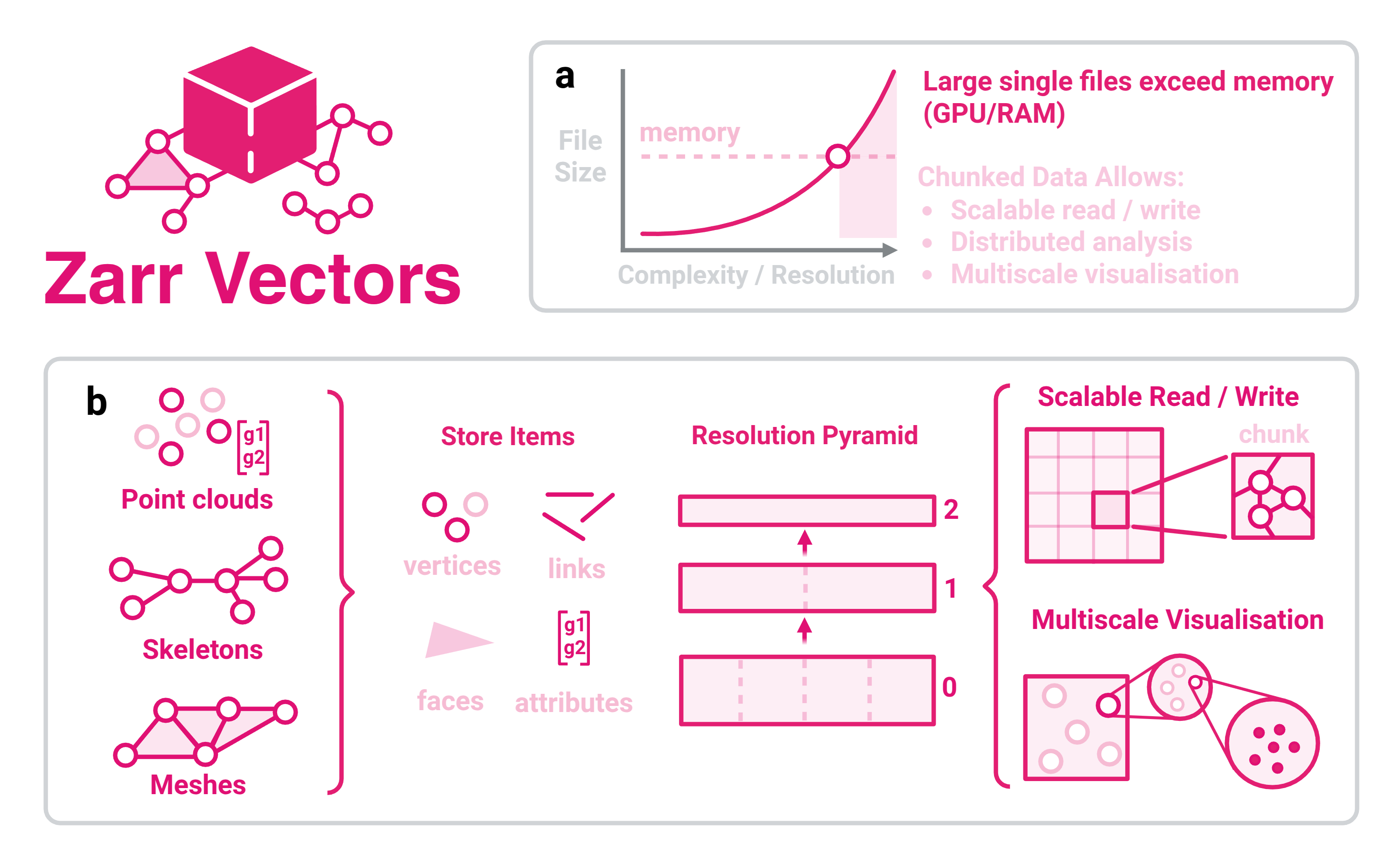
Overview of Zarr Vectors. a — Complex and detailed derivative datasets exceed GPU and system memory. b — Summary of the Zarr Vectors concept, showing input data types, construction, and uses.
Where to start
Install the package and its optional extras. |
|
Create, write, query and validate your first store. |
|
The terms used throughout: chunks, bins, fragments, objects and levels. |
|
A full worked example with the simplest geometry type. |
|
Converting LAS, PLY, TRX, SWC, OBJ and other formats, with the
companion package |
|
The API reference, and which modules are supported. |
|
The full Zarr Vectors specification. |