Core concepts
This page defines the terms the rest of these docs use and explains how a store is organised. The Specification treats each concept in full.
What is Zarr Vectors?
Zarr Vectors is a chunked storage format for spatial vector geometry: point clouds, streamlines, graphs, skeletons and meshes. It is built on Zarr v3. Every array in a store is an ordinary Zarr array, and the resolution pyramid is declared with OME-Zarr metadata, so existing Zarr tools can read a store.
Forrest Collman at the Allen Institute for Brain Science specified the
format. zarr-vectors-py is its Python implementation.
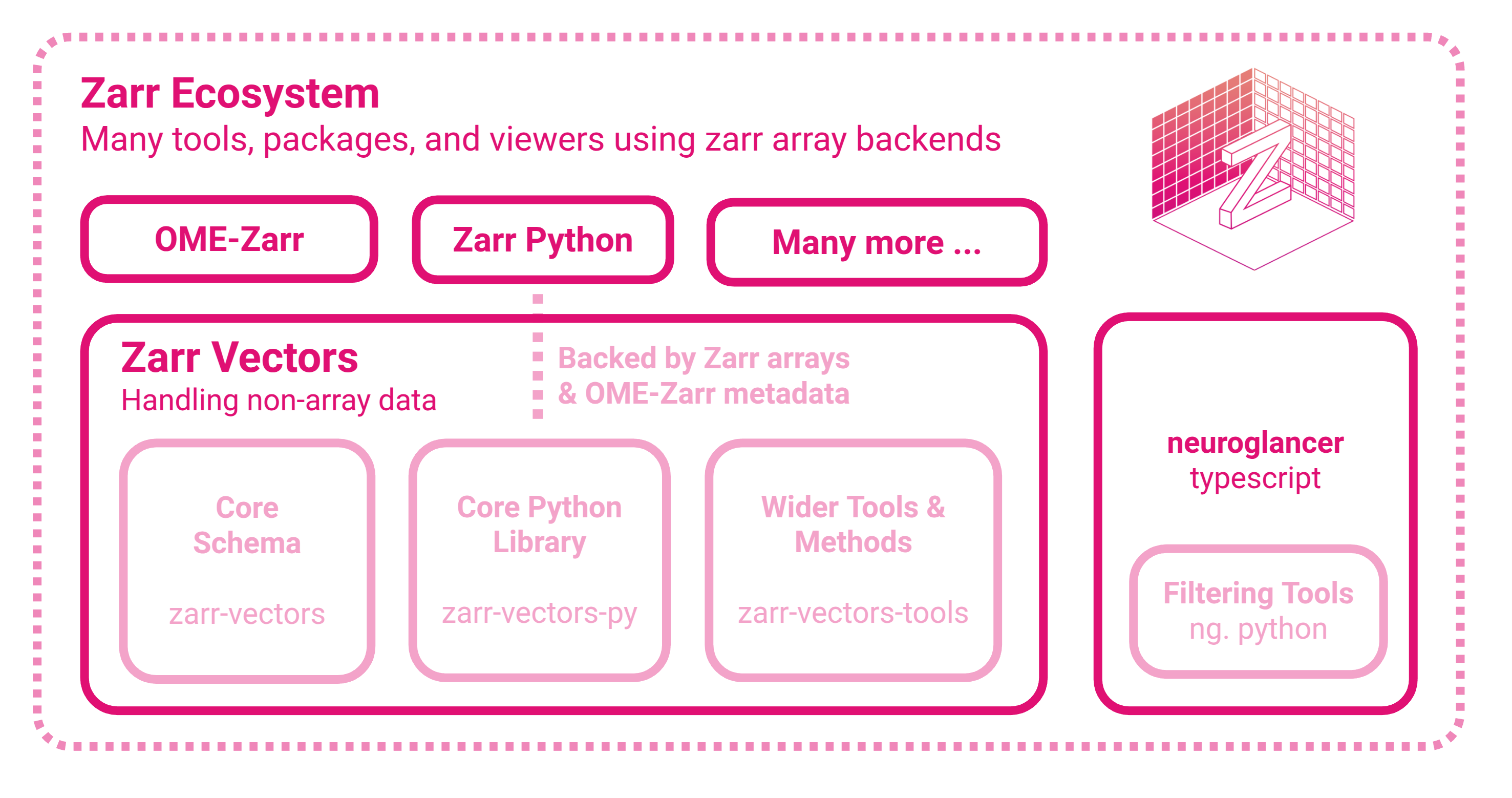
Zarr Vectors in the Zarr ecosystem. The schema (zarr-vectors), this
library (zarr-vectors-py) and the converters and wider methods
(zarr-vectors-tools) are separate packages. Neuroglancer reads the stores
directly.
The store
A store is a Zarr v3 group: a directory on disk or a prefix in cloud
object storage. By convention its name ends in .zarrvectors. The root
zarr.json holds the format’s metadata in its attributes:
attributes.zarr_vectors for store-level fields, including the axes, and
attributes.multiscales listing the pyramid’s levels. Every node with
Zarr Vectors metadata keeps it in one zarr_vectors attribute whose kind
says what the node is (root, level, vertices, …), and registers the
Zarr Vectors convention
in zarr_conventions.
scan.zarrvectors/
├── zarr.json              root attributes: zarr_vectors, multiscales, ome
├── 0/                     level 0, full resolution
│   ├── zarr.json          level attributes: zarr_vectors (kind "level")
│   ├── vertices/          vertex positions, one cell per occupied chunk
│   ├── vertex_fragments/  fragment index into vertices/
│   ├── vertex_attributes/ one array per attribute name
│   ├── links/             edges, as links/<delta>/<offsets>/
│   ├── link_fragments/    fragment index over intra-chunk links
│   ├── link_attributes/   mirrors links/
│   ├── fragment_attributes/
│   ├── object_index/      manifests/ and object_ids/
│   ├── object_attributes/ one row per object
│   ├── groups/            row g lists group g's object ids
│   └── group_attributes/
└── 1/                     a coarser level
A new store has only the root group, a 0/ group, and empty vertices/
and vertex_fragments/ arrays. The other arrays appear when the matching data is
written:
Kind |
Level-0 arrays |
|---|---|
|
|
|
|
|
|
Any kind gets object_index/ once object ids are written. Attribute arrays
and groups/ appear only when you pass that data. fragment_attributes/ and
group_attributes/ are written only through zarr_vectors.building. The root
can also hold parametric/ (analytic shapes) and headers/ (preserved
source-format headers). Directory structure
gives the full tree for each geometry.
Chunks
A chunk is the unit of I/O: one file per occupied chunk in each array. On
the zarr_vectors.api surface a chunk is called a cell. A spatial read
finds the chunks that overlap the region and reads only those.
Each chunk holds a different number of vertices, so the arrays are ragged. An
array’s shape is the chunk grid, and each occupied position holds one
variable-length bytes cell (Zarr v3’s vlen-bytes codec), not a padded dense
array. Attribute arrays use the same grid, row-aligned with vertices/.
The chunk size is in the units of your coordinates and is the same across a
level. You set it on the schema’s Layout: cells= gives the number of
chunks per axis, and cell_size= gives the size directly. Bounds are
inclusive, so 1000 µm bounds with cells=5 give a grid of 6 × 6 × 6 chunks of
200 µm.
Larger chunks mean fewer files and larger reads; they suit batch processing
and network file systems. Smaller chunks make small-region queries faster;
they suit interactive viewing. With no cells=, the layout makes one chunk
for the whole volume, or chunks of about 64 MB when the schema has
expected=zv.SizeHints(n_vertices=...). See
Choosing a layout.
Bins
A bin is a subdivision of a chunk and the unit of the spatial index. A
bounding-box query resolves to bins, so it can read part of a chunk.
Layout(subcells=n) puts n bins per chunk on each axis (default 4, so 64
bins per chunk in 3-D). subcells=1 makes the bin the same as the chunk.
Level.scale reports the chunk shape and Level.resolution the bin shape.
Fragments
A fragment is one entry in a chunk’s fragment index. It names a
contiguous range of rows in that chunk’s vertices/ cell, or a list of row
indices. At level 0 each non-empty bin has one fragment. So a bounding-box
query becomes a set of (chunk, fragment) pairs, each read without the rest
of the chunk. Fragments address rows, not bytes, so two fragments can share a
vertex. See Fragments.
Objects, manifests and groups
An object is one discrete item: a streamline, a skeleton, a mesh, or a
labelled set of points. Each object has an integer id. Its manifest is
one row of object_index/manifests/, listing every chunk the object touches
and the fragments in each. Reading one object decodes its manifest and reads
the fragments it names, with no chain of dependent reads.
At coarser levels two manifests can name the same fragment, a shared
fragment; the vertex row is stored once. A group is a set of objects,
stored as one row of groups/. See
Object manifest.
Links
A link is an edge between vertices, stored under
links/<delta>/<offsets>/. <delta> is how many levels the link spans: 0
within a level, +1 or -1 to the next level. <offsets> is where the other
end sits relative to the chunk holding the record: 0.0.0 is within the
chunk, 0.0.+1 one chunk along +z. A link with non-zero offsets is a
cross-chunk link. Polylines write no link_fragments/, because vertex
order gives their edges within a chunk. Object reads do not use links: the manifest already
names every chunk.
Levels and the pyramid
A level is one resolution of the data, stored as a numbered group (0/,
1/, …). Level 0 is full resolution. Dataset.build_pyramid adds coarser
levels. It takes one (coarsen_factor, sparsity_factor) pair per new level,
each relative to the level below, so the factors compound.
The coarsening factor scales the bin shape on every axis. The vertices in
each bin merge into one metavertex, so a factor of 2 cuts the vertex count
by up to 8 in 3-D. chunk_scale_factors= grows the chunk shape too; without
it every level keeps the level-0 chunk shape.
The object sparsity factor thins objects. A factor of 2 keeps half of
them, chosen at random with a seed, and the level records
object_sparsity: 0.5. Kept objects keep their ids. zarr-vectors-tools
adds ranked selection strategies.
A coarser level has vertices, vertex_fragments, object_index,
links/-1/ back to its parent, and the parent’s object_attributes. It has
no vertex_attributes, groups, group_attributes, link_attributes or
link_fragments. See
Building pyramids.
Multiscale metadata
The root attributes.multiscales block follows the
multiscales convention,
so tools that know it can find the levels:
{"layout": [{"asset": "0"}, {"asset": "1"}, ...]}. Every level stores its
vertices in level-0 coordinates, so the block has no transform.
Format-specific fields stay outside this block: axes, bounds,
chunk_shape and base_bin_shape in the root attributes.zarr_vectors,
and vertex_count, bin_shape, bin_ratio, object_sparsity and others
in each level’s attributes.zarr_vectors.
Geometry types
Constant |
Value |
Description |
|---|---|---|
|
|
Unconnected vertices |
|
|
Pairs of vertices (line segments) |
|
|
Ordered vertex sequences |
|
|
Polylines from tractography |
|
|
Vertices and edges, directed or undirected |
|
|
Tree-structured graph, as in SWC |
|
|
Triangulated surface with faces |
The constants are in zarr_vectors.constants. All types share the same
chunked layout. Types other than point clouds also have object_index/ and
links/.
Coordinates and units
Coordinates are stored as given, and chunk and bin shapes use the same
units. The schema’s axes (for example zv.Axis("x", unit="micrometer"))
name the axes and units in the root zarr_vectors.axes and in the ome
node. An optional coordinate reference system, a PROJJSON object in the
root attribute proj:projjson, is written with
zarr_vectors.building.create_store(..., crs=...); Schema does not take
one.
Summary
Term |
What it is |
Set by |
|---|---|---|
Store |
A Zarr v3 group, named |
the path passed to |
Chunk (cell) |
Unit of I/O; one file per occupied chunk |
|
Bin |
Unit of the spatial index within a chunk |
|
Fragment |
One entry in a chunk’s fragment index |
computed |
Object |
One discrete item with an integer id |
object ids at write time |
Manifest |
An object’s |
computed |
Group |
A set of objects |
|
Link |
An edge, stored as |
computed |
Level |
One resolution of the data |
|
Coarsening factor |
Bin growth per level |
first element of each |
Object sparsity |
Object thinning per level |
second element of each |