Directory structure
This page shows the on-disk tree of a Zarr Vectors store for each geometry type, and which paths each writer creates.
Terms
- Store root
The directory (or object-store prefix) holding the root
zarr.json, the level groups and, optionally,parametric/. Use the extension.zarrvectors;.zvis an accepted short form. Nothing reads the extension.
Level groups, per-chunk arrays and link families are defined on Level groups, Chunk arrays and Links.
Introduction
A store is a Zarr v3 hierarchy: a root group, one group per level, and the
arrays of each level. All metadata is in the attributes of the
zarr.json files; the trees below omit most of them.
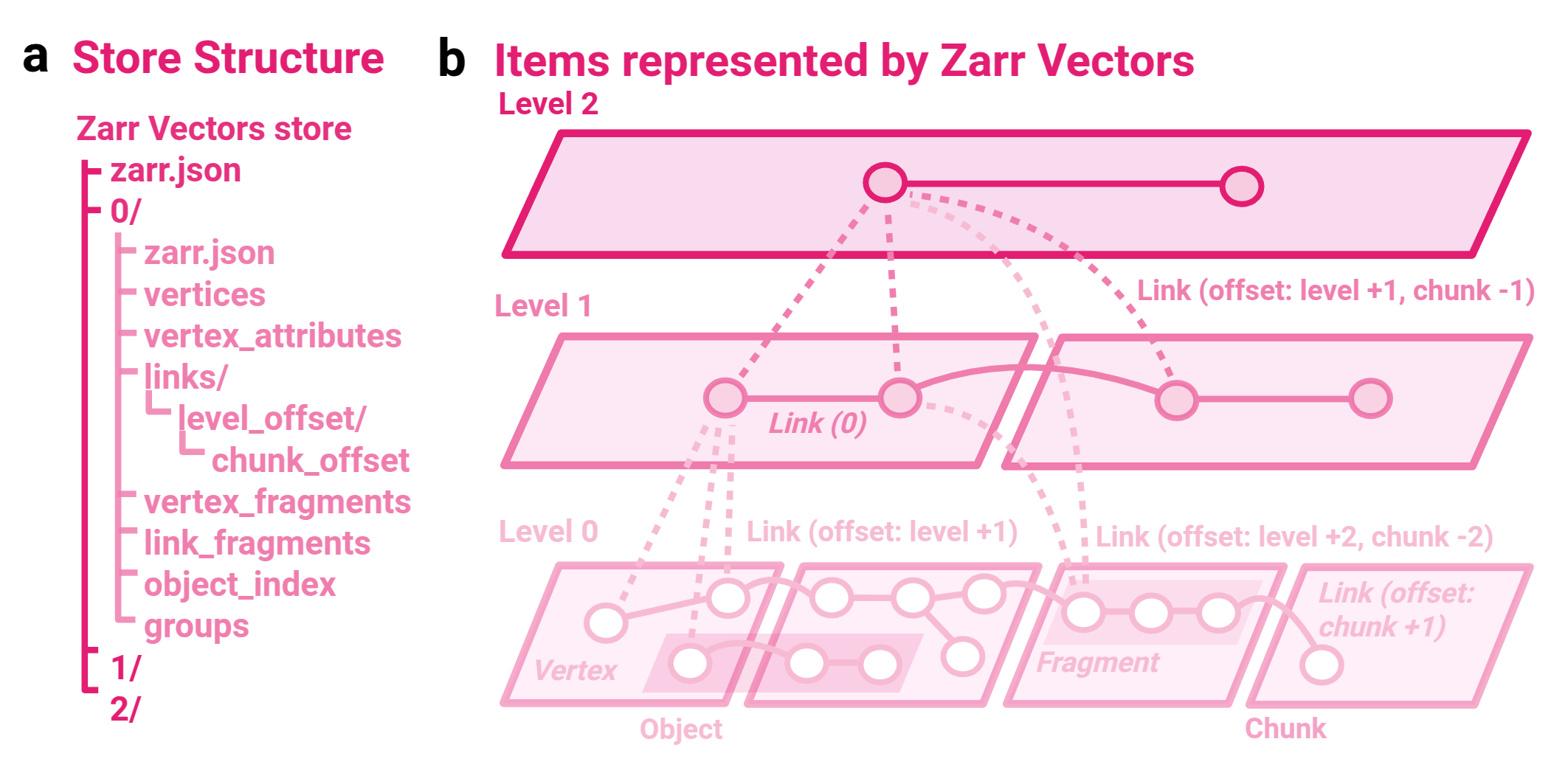
Zarr Vectors data structure. a — A three-level store, with level 0 expanded. b — Vertices, links with chunk and level offsets, and objects split into fragments, across the same three levels.
Technical reference
The trees come from the writers in zarr_vectors.types, with
chunk_shape=(200, 200, 200) over bounds [0, 400] on each axis.
Point cloud
write_points(..., vertex_attributes={"intensity": ..., "label": ...}):
points.zarrvectors/
├── zarr.json                 # root attributes: see root_metadata.md
└── 0/
    ├── zarr.json             # level attributes: see level_groups.md
    ├── vertices/
    │   ├── zarr.json
    │   └── c/0/0/0, c/0/0/1, …   # one file per non-empty chunk
    ├── vertex_fragments/
    └── vertex_attributes/
        ├── intensity/
        └── label/
create_store alone writes the root and 0/ with empty vertices/
and vertex_fragments/ arrays, so a new store is already structurally
valid.
Streamline, polyline and line
write_polylines(..., object_attributes=..., groups=..., group_attributes=...). write_lines writes the same tree:
streamline.zarrvectors/
├── zarr.json
└── 0/
    ├── zarr.json
    ├── vertices/
    ├── vertex_fragments/
    ├── links/
    │   └── 0/                # level delta 0
    │       ├── +1.0.0/       # segments whose next vertex is one chunk along +x
    │       ├── 0.+1.0/
    │       └── 0.0.+1/
    ├── object_index/
    ├── object_attributes/
    ├── groups/
    └── group_attributes/
Vertex order links consecutive vertices within a chunk, so these stores
have only cross-chunk link arrays: no links/0/0.0.0/ and no
link_fragments/.
Graph and skeleton
write_graph(..., link_attributes={"weight": ...}):
graph.zarrvectors/
├── zarr.json
└── 0/
    ├── zarr.json
    ├── vertices/
    ├── vertex_fragments/
    ├── links/
    │   └── 0/
    │       ├── 0.0.0/        # edges with both ends in the cell
    │       ├── 0.0.+1/       # edges to the neighbour along +z
    │       └── …             # one array per offset that occurs
    ├── link_fragments/       # fragment index over links/0/0.0.0/ only
    ├── link_attributes/
    │   └── weight/0/…        # same arrays as links/0/
    └── object_index/
write_graph(..., kind="skeleton") writes the same tree.
Mesh
write_mesh writes the graph tree without link_attributes/. Its link
arrays have link_width 3, one row per triangle. Each segment name joins
two offsets with _, one per non-source vertex:
mesh.zarrvectors/0/
├── links/
│   └── 0/
│       ├── 0.0.0_0.0.0/      # triangle wholly inside the cell
│       ├── 0.0.0_0.0.+1/     # third vertex one chunk along +z
│       └── …
└── link_fragments/           # fragment index over links/0/0.0.0_0.0.0/
Pyramid
build_pyramid(..., factors=[(2, 2), (2, 2)]) on the streamline store adds
levels 1/ and 2/, each with vertices/, vertex_fragments/ and
object_index/, and cross-level link families:
streamline_pyr.zarrvectors/
├── zarr.json                 # multiscales and ome list all three levels
├── 0/
│   └── links/
│       ├── 0/                # as in the single-level store
│       └── +1/0.0.0/         # each level-0 vertex to its level-1 vertex
├── 1/
│   └── links/
│       ├── +1/0.0.0/         # to level 2
│       └── -1/0.0.0/         # to level 0
└── 2/
    └── links/
        └── -1/0.0.0/
Coarser streamline levels have no links/0/. For how cross-level offsets
are measured, see
Links.
Parametric objects
write_parametric_objects adds an unchunked parametric/ group at the
store root:
param.zarrvectors/
├── zarr.json
├── 0/ …
└── parametric/
    ├── zarr.json             # attributes: parametric_types
    ├── objects/              # float64, [num_objects, max_row_length]: type ID, then coefficients
    ├── names/                # variable_length_bytes, one name per object
    ├── object_attributes/
    ├── groups/
    └── group_attributes/
parametric_types maps each type ID to its name and coefficient names:
0 plane, 1 line and 2 sphere are built in.
Names and presence
Level groups are named 0, 1, 2, …;
L5 validation requires them to run from 0
without gaps. Other root children, except parametric/ and headers/
(source-format headers, such as headers/trx/, kept by
zarr_vectors.headers.HeaderRegistry), are not part of the format. Array names within a level are fixed. In a sharded store the
tree is the same, but each file under c/ is a shard holding a block of
cells; see Sharding.
Path |
Present in |
|---|---|
|
Every store (L1 error if missing) |
|
Every store this package writes (L1 warning if missing) |
|
Every level (L1 error if missing) |
|
Every level (L1 warning if missing) |
|
Lines, polylines, streamlines (cross-chunk only); graphs, skeletons, meshes |
|
Graphs, skeletons, meshes |
|
Pyramids with |
|
Every type except a point cloud written without |
|
When the writer gets that kind of attribute |
|
When the writer gets |
|
When parametric objects are written |