14. Examples¶
This section gives concrete store layouts and use-case details for
the data model. Directory trees show the Zarr v3 group/array
structure; chunk keys follow the spatial chunk grid (<i.j.k> for
3-D, <i.j> for 2-D, etc.). Metadata snippets show the on-disk
zarr.json content under the "zarr_vectors" / "zarr_vectors_level"
namespaces; standard Zarr v3 fields (shape, chunk_grid, codecs,
…) are omitted for brevity.
These examples are format-only — they describe what a writer
would emit on disk. Language bindings for reading/writing each
layout live in the zarr-vectors-py package (write_points,
write_mesh, …) and are out of scope for this chapter.
14.1 Mouse Brain Nuclei: Point Cloud with Multi-Resolution and Regions¶
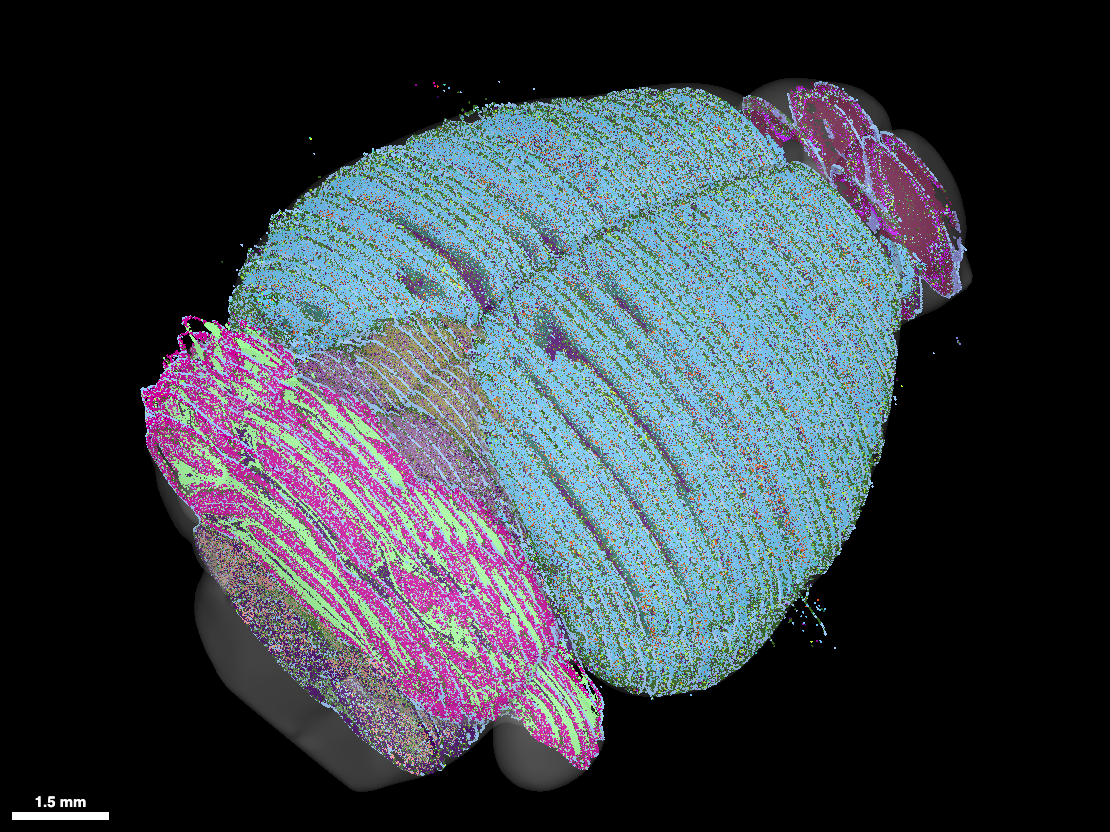
Use case: Single-cell positions from a cleared mouse brain (cell nuclei centroids). Each nucleus is an object with a volume attribute. Nuclei are grouped by brain region. Multi-resolution supports coarse-to-fine visualization.
Directory structure:
mouse_brain_nuclei.zarrvectors/
├── zarr.json                              # root: zarr_vectors + multiscales
├── 0/
│   ├── zarr.json                          # zarr_vectors_level
│   ├── vertices/
│   │   ├── zarr.json                      # nonempty_chunks, chunk_grid_origin
│   │   └── c/
│   │       ├── 0/0/0
│   │       ├── 0/0/1
│   │       └── …
│   ├── vertex_fragments/
│   │   ├── zarr.json                      # zv_array = "vertex_fragments"
│   │   └── c/0/0/0, …
│   ├── vertex_attributes/
│   │   └── volume/
│   │       ├── zarr.json                  # µm³ per nucleus
│   │       └── c/0/0/0, …
│   ├── object_index/
│   │   ├── zarr.json                      # layout = "vlen_manifests_v1"
│   │   └── manifests                      # one manifest blob per nucleus
│   ├── groups                             # G regions → object id lists
│   └── group_attributes/
│       └── region_name                    # (G,) — "cortex", "hippocampus", …
├── 1/                                     # coarser pyramid level
│   ├── zarr.json                          # may carry bin_shape and/or chunk_shape
│   ├── vertices/
│   ├── vertex_fragments/
│   ├── vertex_attributes/
│   │   └── volume/
│   ├── object_index/                      # preserves_object_ids = true
│   ├── groups                             # same membership, same OID space
│   └── group_attributes/
│       └── region_name
└── 2/
    └── …                                  # further downsampled for coarse preview
Root metadata (zarr.json["zarr_vectors"]):
{
  "zv_version": "0.9.0",
  "chunk_shape": [200.0, 200.0, 200.0],
  "bounds": [[0,0,0],[1000,1000,1000]],
  "geometry_types": ["point_cloud"],
  "links_convention": "implicit_sequential",
  "object_index_convention": "standard",
  "cross_chunk_strategy": "explicit_links",
  "cross_level_storage": "explicit",
  "cross_level_depth": 1,
  "base_bin_shape": [50.0, 50.0, 50.0],
  "format_capabilities": ["fragment_index", "shared_fragments",
                          "preserved_object_ids", "multiscale_links"]
}
Notes:
Objects: one nucleus per object; each nucleus is a single fragment (mode-0 manifest block).
What a fragment is in this example: one nucleus inside one chunk. Inside
vertex_fragments/<chunk>it’s a length-1 range(start, 1)whosestartis the nucleus’s row index invertices/<chunk>. The fragment count per chunk equals the nucleus count for that chunk. The fragment index is what lets theobject_index/manifestsblob reference a nucleus by chunk-local position without writing global vertex IDs anywhere; it’s a small cost (header + bitmap + range table, no CSR) and is what a reader uses to translate(chunk_coords, fragment_index)from a manifest block back into a row ofvertices/<chunk>.Alternative — undifferentiated point cloud: if the store doesn’t need per-nucleus identity (no
object_idsat write time), the writer takes the per-bin path instead: each chunk’svertex_fragments/<chunk>has one fragment per bin (here200/50 = 4per axis → 64 fragments per chunk), and a fragment carries every nucleus that falls in that bin. Noobject_index/in that case; the fragment index is purely a sub-chunk spatial filter.Object index: required (multi-chunk). Each manifest is one block:
(chunk_coords, mode=0, fragment_index=k).Vertex attributes:
volume(µm³) per nucleus, row-aligned tovertices/<chunk>.Groups: one entry per brain region; each carries a list of nucleus object IDs.
Group attributes:
region_name(string per group).Multi-resolution: per-object pyramid with coarser
bin_shapeat each level; coarse levels may growchunk_shapeto amortise overhead.+1/-1cross-pyramid-level link arrays drill from fine to coarse — see §9.6.
14.2 Mesh with Multi-Resolution (chunk-scale growth)¶
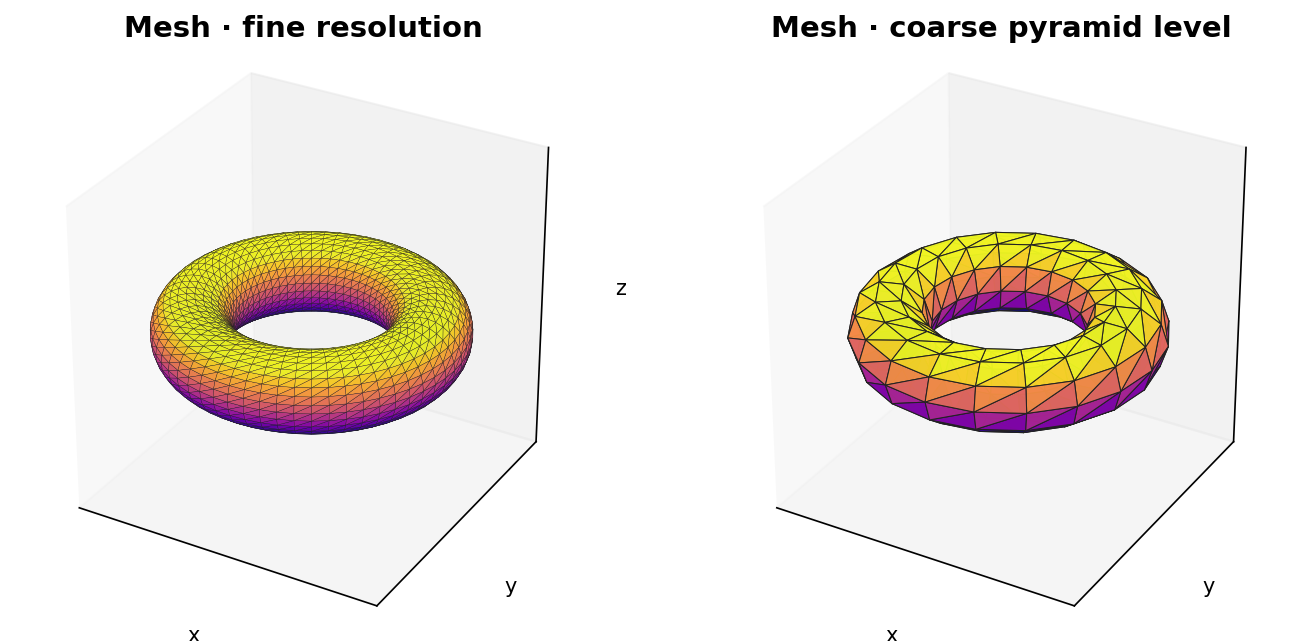
Use case: Surface mesh of a Drosophila brain compartment.
Triangular mesh, Draco-encoded vertices and faces, three resolution
levels — coarser levels grow the chunk shape so each coarse chunk
covers 2³ fine chunks.
Directory structure:
drosophila_central_complex_mesh.zarrvectors/
├── zarr.json
├── 0/
│   ├── zarr.json                          # chunk_shape inherits root
│   ├── vertices/                          # Draco-encoded vertex cells
│   │   ├── zarr.json                      # encoding = "draco"
│   │   └── c/0/0/0, …
│   ├── vertex_fragments/
│   │   ├── zarr.json
│   │   └── c/0/0/0, …
│   ├── links/
│   │   └── 0/                             # GROUP — link_width = 3
│   │       ├── zarr.json                  # link_width = 3, directed = true
│   │       ├── 0.0.0_0.0.0/               # faces inside one chunk
│   │       │   └── c/0/0/0, …
│   │       ├── 0.0.+1_0.0.+1/             # faces straddling the +z seam
│   │       │   └── c/0/0/0, …
│   │       └── 0.0.+1_0.+1.0/             # faces spanning three chunks
│   │           └── c/0/0/0, …
│   ├── link_fragments/                    # partitions links/0/0.0.0_0.0.0 only
│   │   ├── zarr.json
│   │   └── c/0/0/0, …
│   └── object_index/
│       ├── zarr.json
│       └── manifests
├── 1/                                     # chunk_shape = 2× root per axis
│   ├── zarr.json                          # zarr_vectors_level.chunk_shape set
│   ├── vertices/
│   ├── vertex_fragments/
│   ├── links/
│   │   ├── 0/                             # same-level faces at level 1
│   │   │   └── 0.0.0_0.0.0/, 0.0.+1_0.0.+1/, …
│   │   ├── +1/                            # OPTIONAL: fine→coarse mapping
│   │   └── -1/                            # OPTIONAL: explicit storage only
│   └── object_index/
└── 2/                                     # chunk_shape = 4× root per axis
    └── …
Level-1 metadata (zarr.json["zarr_vectors_level"]):
{
  "level": 1,
  "vertex_count": 24310,
  "arrays_present": ["vertices","vertex_fragments","links","link_fragments",
                     "object_index"],
  "chunk_shape": [400.0, 400.0, 400.0],
  "object_sparsity": 1.0,
  "coarsening_method": "manual",
  "parent_level": 0
}
bin_shape and bin_ratio do not appear here: they live in this
level’s NGFF coordinateTransformations entry as translation × 2 and
scale respectively (see §9.3).
arrays_present lists family names only.
Notes:
vertex_fragments: each mesh “fragment” is one Draco-encoded per-chunk piece of the mesh; one fragment per chunk in the typical case. Explicit fragments allow vertex re-use across fragments when meshes share rims.links/0/0.0.0_0.0.0/: triangle faces wholly inside one chunk,link_width = 3.link_fragmentspartitions those faces by vertex fragment.links/0/0.0.+1_0.0.+1/and friends: faces whose vertices live in distinct chunks. Same family, same record shape — only the offsets segment differs.Chunk-scale growth: level 1’s chunks are
2³× coarser bin-shape than level 0’s, but the grids nest exactly: a level-0 chunk(2,3,4)lives inside the level-1 chunk(1,1,2).links/+1/: optional fine→coarse mapping per §9.6. A+1record sits in its source chunk’s cell at level 0, and its offsets locate the level-1 endpoint relative to that chunk re-anchored into the level-1 grid — which is what keeps chunk-scale growth from scattering one physical relationship across many offsets segments.
14.3 Skeleton with Cross-Chunk Objects¶
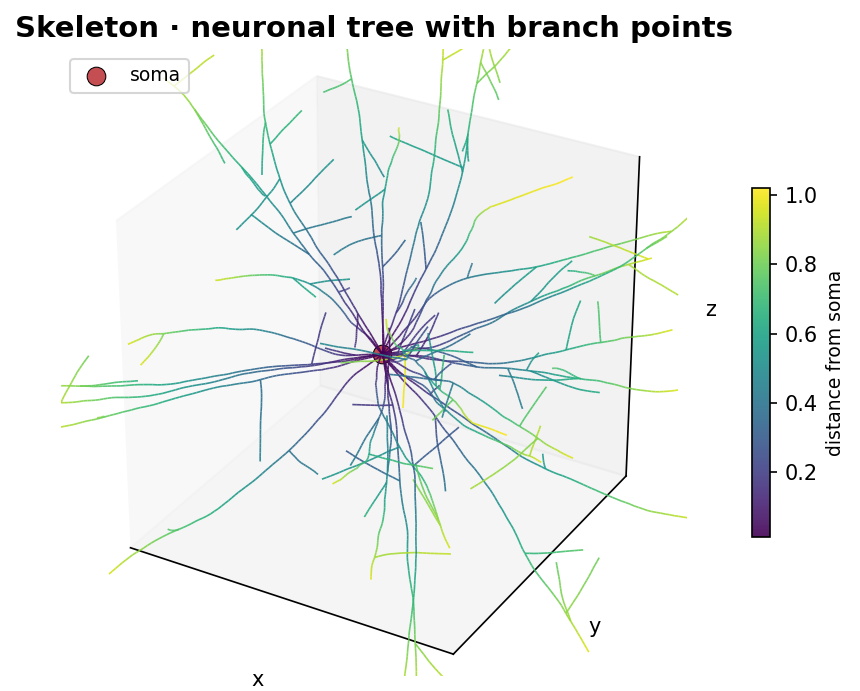
Use case: Neuronal skeletons in a large volume; each neuron is
one object that may span many spatial chunks. Parent links
(link_width = 1) form a tree; most parents are sequential
(parent = i − 1).
Directory structure:
mouse_cortex_skeletons.zarrvectors/
├── zarr.json                              # links_convention = "implicit_sequential_with_branches"
├── 0/
│   ├── zarr.json
│   ├── vertices/
│   │   ├── 2.1.0
│   │   ├── 2.1.1
│   │   └── …
│   ├── vertex_fragments/
│   │   ├── 2.1.0                          # one fragment per neuron piece in this chunk
│   │   └── …
│   ├── links/
│   │   └── 0/                             # GROUP — link_width = 2, directed = true
│   │       ├── zarr.json                  # branch links only (implicit sequential)
│   │       ├── 0.0.0/                     # parent→child inside one chunk
│   │       │   └── c/2/1/0, …
│   │       └── 0.0.+1/                    # parent→child crossing the +z seam
│   │           └── c/2/1/0, …
│   ├── link_fragments/                    # partitions links/0/0.0.0 only
│   │   └── c/2/1/0, …
│   ├── vertex_attributes/
│   │   ├── vertex_type/                   # 0=soma, 1=axon, 2=dendrite
│   │   │   └── c/2/1/0, …
│   │   └── radius/                        # µm
│   │       └── c/2/1/0, …
│   └── object_index/
│       └── manifests                      # B = number of neurons
└── 1/
    └── …                                  # per-object pyramid; preserves_object_ids
Root metadata snippet:
{
  "links_convention": "implicit_sequential_with_branches",
  "object_index_convention": "standard",
  "cross_chunk_strategy": "explicit_links",
  "format_capabilities": ["fragment_index","preserved_object_ids","multiscale_links"]
}
Notes:
Implicit-sequential-with-branches dramatically reduces link storage: a 10k-vertex neuron with 50 branches stores ~50 link rows in
links/0/0.0.0instead of ~10k. The convention applies to the intra-chunk array only; a parent edge that leaves the chunk is always written out.Per-chunk fragmentation: one fragment per neuron-piece-in-chunk. Neuron 42 might own fragment 3 of chunk
2.1.0and fragment 0 of chunk2.1.1.Object manifest for neuron 42: two blocks —
(chunk=(2,1,0), mode=0, fragment_index=3)and(chunk=(2,1,1), mode=0, fragment_index=0), read from row 42 ofobject_index/manifests.Cross-chunk parent links: a parent in chunk
(2,1,0)with its child one step along+z→ one record in thelinks/0/0.0.+1cell at(2,1,0), holding(parent_vi, child_vi). The child’s chunk is the cell plus the offset; both indices are local to their own chunk. Because the family setsdirected = true, parent→child order is preserved verbatim and no permutation index is stored.link_width = 2, not 1. A barelink_width = 1parent reference has no offsets to encode and so cannot name a second chunk; it is the right shape for a cross-level pointer, not for a parent edge that may cross a chunk seam.
14.4 2-D Polylines with Attributes¶
Use case: Blood-vessel centerlines (polylines) in a 2-D slice with radius and type per vertex.
Directory structure:
retina_vessels_2d.zarrvectors/
├── zarr.json                              # sid_ndim = 2; chunk_shape = [512,512]
├── 0/
│   ├── zarr.json
│   ├── vertices/
│   │   └── c/0/0, …
│   ├── vertex_fragments/
│   │   └── c/0/0, …
│   ├── vertex_attributes/
│   │   ├── radius/                        # µm
│   │   │   └── c/0/0, …
│   │   └── vessel_type/                   # uint8: 0=artery, 1=vein, 2=capillary
│   │       └── c/0/0, …
│   └── object_index/
│       └── manifests
└── …
Notes:
links_convention = "implicit_sequential"(nolinks/group at all unless branches exist).One object per vessel. Manifest: one block per chunk the vessel passes through.
Per-vertex attributes (
radius,vessel_type) row-aligned to theverticescell at the same chunk coordinate.
14.5 Time-Series Point Cloud (XYZT)¶
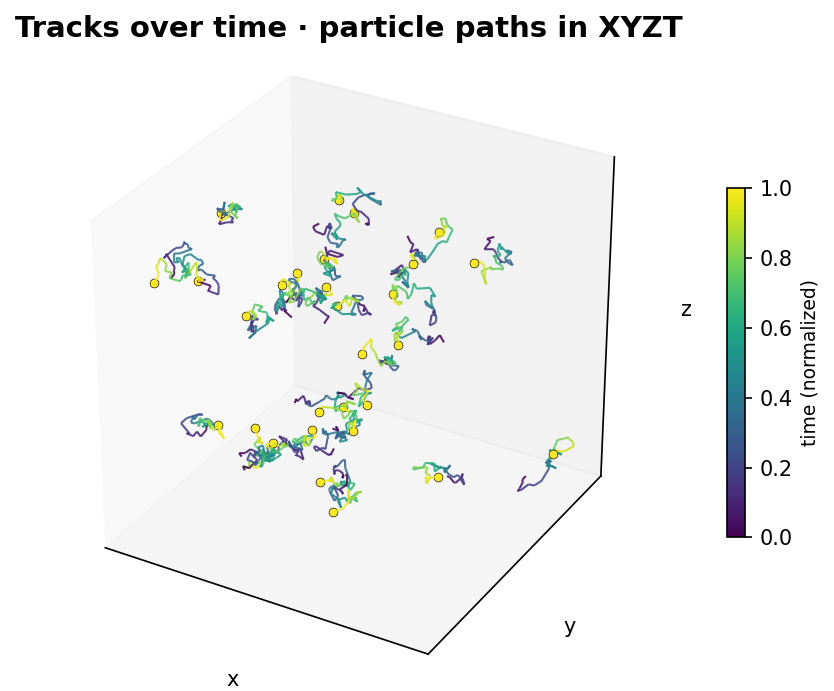
Use case: Tracking spots in 3-D over time; points are (x, y, z, t).
Directory structure:
cell_tracks_xyzt.zarrvectors/
├── zarr.json                              # 4 space axes: x, y, z, t (t typed as "time")
├── 0/
│   ├── zarr.json
│   ├── vertices/                          # 4-D chunk grid
│   │   └── c/
│   │       ├── 0/0/0/0                    # (x,y,z,t) chunk
│   │       ├── 0/0/0/1
│   │       └── …
│   ├── vertex_fragments/
│   │   └── c/0/0/0/0, …
│   └── object_index/
│       └── manifests                      # one object = one track across t-chunks
└── …
Notes:
NGFF axis order is
time, channel, custom, space— thetaxis is declared first (type = "time"); chunk coords listtlast by convention so the spatial-only chunk grid stays compact.Time-range queries read only the relevant
tchunks.Each track’s manifest lists one block per
(x,y,z,t)chunk the track passes through.
14.6 Multiplexed FISH: Gene Measurements and Cell Types¶
Use case: Multiplexed FISH (MERFISH / seqFISH). Each vertex is a cell centroid; vertex attributes are gene counts (many channels) and cell type; objects are cells; groups are cell-type clusters.
Directory structure:
merfish_celltype.zarrvectors/
├── zarr.json
├── 0/
│   ├── zarr.json
│   ├── vertices/                          # cell positions (XY)
│   │   └── c/0/0, …
│   ├── vertex_fragments/
│   │   └── c/0/0, …
│   ├── vertex_attributes/
│   │   ├── gene_expression/               # multi-channel per cell
│   │   │   ├── zarr.json                  # row_shape = [num_genes],
│   │   │   │                              #   channel_names = ["GENE0", …]
│   │   │   └── c/0/0, …
│   │   └── cell_type/                     # uint16 type id per cell
│   │       └── c/0/0, …
│   ├── object_index/
│   │   └── manifests                      # one object per cell
│   ├── groups                             # G cell-type clusters
│   └── group_attributes/
│       ├── cell_type_name
│       └── super_type                     # e.g. "neuron", "glia"
└── …
Notes:
gene_expression is stored as one multi-channel attribute (one cell per chunk, shape
(N_chunk, num_genes)).row_shapeon the array carries the column count, so the attribute reads back at its true width whether or notchannel_namesis present. When the gene count is large enough that channel-axis chunking is desirable, the store rechunks along the gene axis usingchunk_dims = ["gene","dim0","dim1"]with per-binchunk_attribute_values(see §8.3 and therechunkworkflow).groups + group_attributes/super_type: hierarchical typing is expressed via group attributes, not parent-pointer structure.
14.7 Individual Gene Detections in mFISH (Spots → Cells)¶
Use case: Raw multiplexed FISH where each vertex is one transcript spot. Spots agglomerate into cells (objects). Many spots per cell.
Directory structure:
mfish_spots_cells.zarrvectors/
├── zarr.json
├── 0/
│   ├── zarr.json
│   ├── vertices/                          # XYZ position per spot
│   │   └── c/0/0/0, …
│   ├── vertex_fragments/
│   │   └── c/0/0/0, …
│   ├── vertex_attributes/
│   │   ├── gene_id/                       # which transcript
│   │   ├── intensity/                     # fluorescence
│   │   └── round/                         # imaging round
│   ├── object_index/
│   │   └── manifests                      # one object per cell; each cell
│   │                                       # spans many fragments / chunks
│   ├── object_attributes/
│   │   ├── cell_type                      # (B,)
│   │   └── centroid                       # (B, 3)
│   └── groups                             # optional cell-type clusters
└── …
Notes:
A cell that spans chunks gets one manifest block per chunk; within a chunk the spots belonging to that cell can be a range (mode 1) if writer ordering allowed, or an explicit list (mode 2) otherwise.
object_attributes/centroidis(B, 3)— pre-computed per-cell summaries so a viewer can render cells without fetching every spot. A cell with no centroid reads back as the array’sfill_value(NaN here), not as a zero row.
14.8 Simple DTI: Small Volume (TRX-Aligned)¶
Use case: Small DTI tractography dataset (single subject, cropped region) where spatial chunking is unnecessary. The store collapses to a single spatial chunk; the layout closely aligns with the TRX format to simplify conversion and interoperability.
TRX alignment (mapping to Zarr Vectors):
TRX |
Zarr Vectors |
|---|---|
|
|
|
|
|
|
|
|
|
|
|
|
|
root |
Directory structure:
dti_small.trx.zarrvectors/
├── zarr.json                              # object_index_convention = "identity",
│                                           # links_convention      = "implicit_sequential"
└── 0/
    ├── zarr.json
    ├── vertices/
    │   └── c/0/0/0                        # all positions in one cell
    ├── vertex_fragments/
    │   └── c/0/0/0                        # one fragment per streamline,
    │                                       # ranges = TRX offsets
    ├── vertex_attributes/
    │   ├── fa/
    │   │   └── c/0/0/0
    │   └── color/                         # (NB_VERTICES, 3) uint8
    │       └── c/0/0/0
    ├── object_attributes/
    │   ├── algo
    │   ├── clusters_QB
    │   └── commit_weights
    ├── groups                             # G tracts → streamline (object) ids
    └── group_attributes/
        ├── tract_name                     # AF_L, AF_R, …
        ├── mean_fa                        # (G,)
        ├── shuffle_colors                 # (G, 3)
        └── volume                         # (G,) uint32
Notes:
Single chunk:
chunk_shapecovers the entire bounding box, so every per-chunk array has grid shape(1, 1, 1)and exactly one cell, atc/0/0/0.Identity convention:
object_index/omitted; object IDs equal fragment indices within the single chunk.Implicit-sequential links: no
links/group at all. Streamlines are recovered by reading the per-streamline fragment from thevertex_fragmentscell and walking vertex rows in order.No vertex_fragments range-table optimization needed: each TRX-style offset becomes one range fragment
(start, count).
14.9 DTI Streamlines: Large Volume with Chunking and Segment Reuse¶
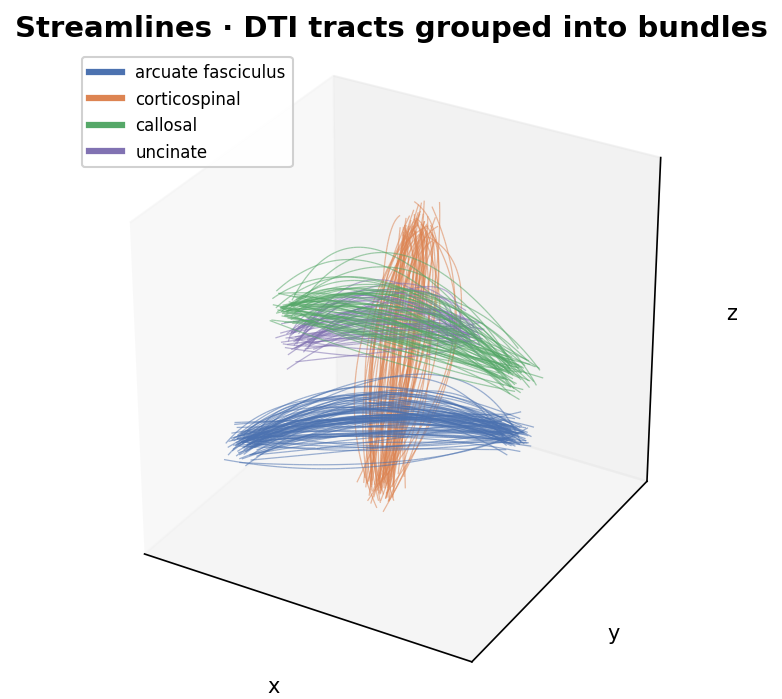
Use case: Diffusion tensor imaging tractography streamlines from
a large brain volume. Each streamline is an ordered point sequence
(no explicit links — connectivity is implicit by vertex order).
Streamlines are grouped into tracts. Segment reuse: streamline
segments within a chunk are stored once and referenced by multiple
objects via shared fragments. Pyramid levels store progressively
downsampled streamlines; coarser levels grow chunk_shape to keep
chunk counts tractable.
Directory structure:
dti_tracts.zarrvectors/
├── zarr.json                              # cross_level_storage = "implicit"
├── 0/
│   ├── zarr.json
│   ├── vertices/                          # ordered points per segment
│   │   └── c/0/0/0, …
│   ├── vertex_fragments/                  # one fragment per shared segment,
│   │   └── c/0/0/0, …                     #   references via explicit indices
│   ├── links/
│   │   └── 0/                             # GROUP — link_width = 2, directed
│   │       ├── 0.0.+1/                    # segment-end → next segment-start,
│   │       │   └── c/0/0/0, …             #   one array per seam direction
│   │       ├── 0.+1.0/
│   │       └── +1.0.0/
│   ├── object_index/
│   │   └── manifests                      # one object per full streamline;
│   │                                       # manifest chains segments by chunk
│   ├── object_attributes/
│   │   └── termination                    # (B, 2): source / sink region ids
│   ├── groups                             # G tracts → streamline IDs
│   └── group_attributes/
│       └── tract_name
├── 1/                                     # chunk_shape grows ×2 per axis
│   ├── zarr.json                          # zarr_vectors_level.chunk_shape set
│   ├── vertices/                          # fewer points per streamline
│   ├── vertex_fragments/
│   ├── links/
│   │   ├── 0/                             # same-level continuations
│   │   └── +1/                            # OPTIONAL fine→coarse mapping;
│   │                                       #   cross_level_storage = "implicit"
│   ├── object_index/                      # preserves_object_ids = true
│   ├── object_attributes/
│   ├── groups
│   └── group_attributes/
└── 2/
    └── …
Root metadata:
{
  "zv_version": "0.9.0",
  "geometry_types": ["streamline"],
  "links_convention": "implicit_sequential",
  "object_index_convention": "standard",
  "cross_chunk_strategy": "explicit_links",
  "cross_level_storage": "implicit",
  "cross_level_depth": 1,
  "format_capabilities": ["fragment_index","shared_fragments",
                          "preserved_object_ids","multiscale_links"]
}
Notes:
Segment reuse via shared fragments: a single fragment in chunk C may be referenced by many streamline manifests. Mode-2 manifest blocks (explicit fragment lists) carry the ordered sequence of shared fragment indices that make up a streamline within that chunk.
Cross-chunk continuation: each segment-end → next-segment-start is one
link_width = 2record in thelinks/0/<offsets>array for that seam direction, written to the source chunk’s cell. Withdirected = truethe along-path order is preserved and no permutation index is stored, so a record is two chunk-local vertex indices and nothing else.Chunk-scale growth: level 1’s
chunk_shapeis 2× root per axis; per-chunk fragment counts stay bounded as the pyramid decimates.Implicit cross-level storage: only the
links/+1/arrays are emitted, at the finer level. Coarse → fine inversion is computed at read time.
14.10 Large-Scale Distributed Write¶
Use case: Concurrent writers append skeleton fragments to the same store (many workers tracing neurons in different tiles).
Considerations (same layout as 14.3):
Chunk-local writes are independent: each chunk’s cell in
vertices,vertex_fragments,links/0/<offsets>,link_fragments, andvertex_attributes/<name>can be authored without coordinating fragment numbering with any other chunk. Every cell is its own chunk file.Presence is shared state:
nonempty_chunksis one attribute on the whole array, so independent per-cell writers must not each update it. They write cells without recording presence, and a coordinator derives the attribute in one pass afterwards.Global arrays need coordination:
object_index/manifestsandgroupsare level-global. Writers either serialize updates or use a transactional backend (e.g. icechunk) that supports atomic multi-blob commits.Sharding changes the unit of contention. Unsharded, two writers touching different cells never conflict. Sharded, the shard file is the unit of atomicity: writers in different shards are still independent, but two writers in the same shard must serialize.
Finalize before sharding: link record counts must be written before the store is sharded, because a shard’s inner index is not derivable from chunk-file names once the cells are packed.
Capability flags: stores that allow segment reuse advertise
shared_fragments; OID-preserving pyramids built on top of these stores additionally advertisepreserved_object_ids.
Summary¶
Example |
sid_ndim |
Objects |
links_convention |
Vertex attributes |
Groups |
|---|---|---|---|---|---|
14.1 Mouse nuclei |
3 (XYZ) |
nuclei |
implicit_sequential |
volume |
region_name |
14.2 Mesh pyramid |
3 (XYZ) |
mesh fragments |
explicit (link_width = 3) |
— |
— |
14.3 Skeletons |
3 (XYZ) |
neurons |
implicit_sequential_with_branches |
vertex_type, radius |
— |
14.4 Polylines |
2 (XY) |
vessels |
implicit_sequential |
radius, vessel_type |
— |
14.5 Tracks |
4 (XYZT) |
tracks |
implicit_sequential |
— |
— |
14.6 Multiplexed FISH |
2 (XY) |
cells |
implicit_sequential |
gene_expression, cell_type |
cell_type_name, super_type |
14.7 mFISH spots → cells |
3 (XYZ) |
cells (many spots) |
implicit_sequential |
gene_id, intensity, round |
— |
14.8 Simple DTI (TRX) |
3 (XYZ) |
streamlines (single chunk) |
implicit_sequential |
fa, color (obj: algo, clusters) |
mean_fa, volume |
14.9 DTI streamlines |
3 (XYZ) |
streamlines |
implicit_sequential |
— (obj: termination) |
tract_name |
14.10 Distributed write |
3 (XYZ) |
(same as 14.3) |
implicit_sequential_with_branches |
— |
— |