10. Linking Across Chunks and Levels¶
10.1 Problem Statement¶
Many objects span more than one spatial chunk — a neuron skeleton that runs through six chunks, a streamline whose path crosses several boundaries, a mesh with triangle faces straddling a seam. Within a chunk, vertex indices are chunk-local and have no global meaning; some additional structure must carry connectivity across chunk boundaries.
This chapter covers two distinct cross-chunk concepts that the schema treats uniformly under one array family:
Cross-spatial-chunk links at one resolution level (
delta = 0). Endpoints in two different chunks at the SAME pyramid level — the classic “two chunks of one skeleton, with an edge linking them.”Cross-pyramid-level links between resolution levels (
delta ≠ 0). Endpoints at the source level paired with endpoints atsource + delta. When the coarse level also growschunk_shape, the source-side chunk coord and target-side chunk coord differ for the same physical region.
Both kinds live under links/<delta>/<offsets>/ with identical record
structure; the <delta> path segment declares which case applies.
Connectivity is one array family, and an intra-chunk link is
simply a link whose relative offsets are all zero — see
§10.6. Factoring the
relationship between endpoints into the path rather than into the
cell coordinate is what makes every link array an ordinary chunk-grid
array: it shards, enumerates and validates exactly like vertices
does, and a record never names a chunk at all.
10.2 Strategy 1: Boundary Deduplication¶
Principle: vertices on chunk boundaries are duplicated into both adjacent chunks. Connectivity is implicit by coordinate matching at read time.
Setting:
cross_chunk_strategy = "boundary_deduplication".Cost: one extra vertex row per shared boundary point (and one extra fragment entry).
Advantages: simplest read path — readers don’t need to consult any cross-chunk index.
Disadvantages: requires precise coordinate alignment; floating- point round-trips can de-align “shared” points; doesn’t scale to cross-pyramid-level cases.
10.3 Strategy 2: Explicit Cross-Chunk Links¶
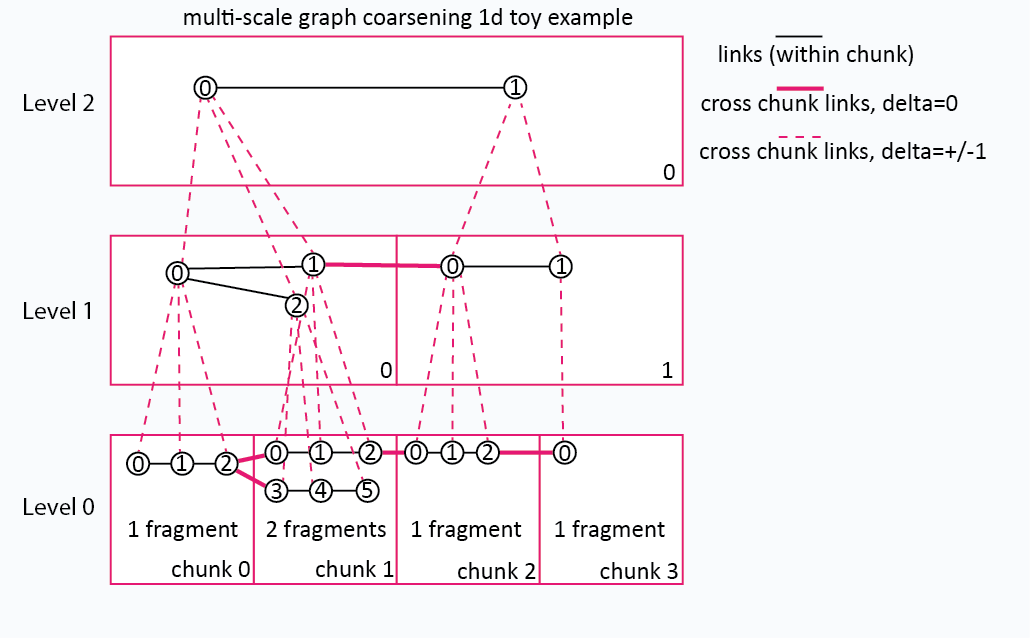
Principle: each cross-chunk edge or face is written as one record in
links/<delta>/<offsets>/, in the cell of its source chunk, where the<offsets>path segment says where the other endpoints sit relative to that source (see §10.6).Setting:
cross_chunk_strategy = "explicit_links"(the default). The strategy tokens are semantic: they say how a writer reconciles geometry that straddles a boundary, not where the records are stored.Record format: see §7.5. Each record carries
link_widthchunk-local vertex indices, one per endpoint.link_width = 2is the generic edge;link_width = 3is a triangle face;link_width = 1is a single child reference (used by metanode drill-down). The chunk each endpoint lives in is recovered from the cell coordinate plus the offsets segment — no chunk coords appear in the record payload.Per-edge attributes (optional):
link_attributes/<name>/<delta>/<offsets>/— the same offsets segments over the same cells, one row per record in the matching link cell.Advantages: explicit, no coordinate matching needed, supports arbitrary
link_width, scales to cross-pyramid-level links viadelta ≠ 0, and makes “all records leaving chunk A in direction d” a single array-cell read.
10.4 Strategy Selection¶
Stores set cross_chunk_strategy in root metadata; the default is
"explicit_links". The third option, "both", emits both
representations — useful for stores whose readers may not all support
explicit cross-chunk links.
Picking guidance:
Use case |
Strategy |
|---|---|
Skeleton with strict integer voxel-coordinate vertices |
either; deduplication is simplest |
Streamline / polyline with float vertices |
|
Mesh with shared rim triangles |
|
Any pyramid with chunk-scale growth |
|
10.5 Object Index for Cross-Chunk Objects¶
When an object spans chunks, its manifest in object_index/manifests
carries one block per chunk it touches. Each block names one chunk and
a fragment reference (mode-0 / mode-1 / mode-2). To reconstruct the
object, a reader:
Reads the object’s manifest blob from
object_index/manifestsat rowobject_id.For each block, decodes the named chunk’s
vertex_fragments/<chunk>to find which rows ofvertices/<chunk>belong to the object.Optionally reads the non-intra offsets arrays under
links/0/at those chunks to recover edges bridging them.
The manifest blocks do NOT themselves carry cross-chunk edges — they carry chunk + fragment references. A manifest references vertex fragments only.
10.6 On-Disk Layout: The Links Family¶
Connectivity is one array family: links/<delta>/<offsets>/, with
link_attributes/<name>/<delta>/<offsets>/ mirroring it. An
intra-chunk link is a link whose relative offsets are all zero.
10.6.1 Array tree¶
/<level>/links/<delta>/                              # GROUP  — family policy
/<level>/links/<delta>/<offsets>/                    # ARRAY  — one per offsets segment
/<level>/link_attributes/<name>/<delta>/             # GROUP  — mirrors the family
/<level>/link_attributes/<name>/<delta>/<offsets>/   # ARRAY  — mirrors cell-for-cell
Each <offsets> array is an ordinary per-chunk array in the sense of
§5.2: a
rank-sid_ndim vlen-bytes array over the level’s chunk grid, one cell
per spatial chunk, cell files at c/<i>/<j>/<k>, with
chunk_grid_origin and nonempty_chunks attributes and optional
sharding. Because the relationship between endpoints is factored into
the path rather than into the cell coordinate, link arrays shard and
enumerate exactly like vertices does.
There is no array at links/<delta> itself — it is always a group.
10.6.2 The <delta> segment¶
The signed pyramid-level delta, written 0, +N, -N. The leading
+ is preserved so a directory listing distinguishes positive deltas
from the unsigned 0 at a glance. It says how many pyramid levels the
record spans: 0 is intra-level, ±N reaches N levels coarser or
finer.
10.6.3 The <offsets> segment¶
The offsets segment says where the record’s other endpoints sit
relative to its source chunk, which is the cell that holds it. It
carries link_width - 1 offsets, each an sid_ndim-tuple of signed
integers written with the same convention as the delta; components are
joined by . and offsets by _.
Segment |
|
Meaning |
|---|---|---|
|
2 |
intra-chunk edge — both endpoints in the source chunk |
|
2 |
edge to the neighbour one chunk along |
|
2 |
edge to the neighbour one chunk along |
|
3 |
intra-chunk triangle |
|
3 |
triangle spanning the source, |
|
1 |
|
The implicit o_0 — the source chunk itself, always zero — is never
encoded. Record component vi_k is a vertex row index local to
chunk src + o_k.
Directory-name invariants, which a reader MUST enforce:
The segment carries exactly
link_width - 1offsets, or is the literalself.Every offset has exactly
sid_ndimcomponents.The segment is
selfifflink_width == 1.
10.6.4 Per-cell payload¶
Two encodings, selected by one condition:
Condition |
Encoding |
Sidecar |
|---|---|---|
|
flat concatenated rows |
|
otherwise |
inline self-describing ragged blob |
none |
The intra-chunk case is a flat row block whose per-fragment partition
lives in the sibling link_fragments array. Every other array — any
non-zero offset, any delta ≠ 0 — carries its own ragged framing
inline
(int64 K, then int64 offsets[K], then the rows) and has no sidecar.
A row is link_width integer columns, or 1 + link_width columns when
the array carries a permutation index in column 0.
10.6.5 Whether a permutation index is present¶
Endpoint order is sometimes data (a directed edge, a mesh face’s
winding) and sometimes an artifact of how the writer canonicalized the
record. has_perm says which, and it is stamped on every array so a
reader never has to infer it:
def links_has_perm(offsets, *, delta, directed, store):
    if is_intra(offsets):     return False   # identity: nothing to canonicalise
    if delta != 0:            return False   # cross-level: source is always endpoint 0
    if store == "duplicate":  return True    # each copy leads with a different endpoint
    return not directed                      # undirected sorts; directed does not
So has_perm is true exactly when the record is non-intra and
delta == 0 and (store == "duplicate" or not directed).
The canonical sort is what keeps an undirected record from being stored
twice. Under store = "canonical" with directed = false, endpoints
are sorted by (chunk_coords, vertex_index) and the smallest becomes
the source — which makes the stored offsets lexicographically
positive, so A→B and B→A are the same cell in the same array
rather than two. perm_idx is what makes that lossless: it is the
Lehmer code of the permutation, so a reader recovers the input order —
mesh-face winding, edge direction — from any stored copy.
A negative offsets segment therefore never arises from a canonical
undirected record. It appears in exactly two situations: a directed
family, where input order is preserved verbatim and A→B and B→A
legitimately file under opposite offsets at different cells; and
store = "duplicate", where the copy anchored at the larger chunk
points back at the smaller one.
The family’s directed and store policy fixes what a cell contains:
|
|
On disk |
|---|---|---|
|
|
one cell, canonical-sorted, |
|
|
one copy per distinct incident chunk, |
|
|
one cell in input order, no |
|
|
one copy per distinct incident chunk, |
"canonical" stores each record once, at one source chunk.
"duplicate" stores one copy per distinct incident chunk, so an
incidence query on any chunk is a single cell read at the cost of a
larger store; num_physical_records then exceeds num_links.
10.6.6 Metadata¶
Family group — links/<delta>/:
{
  "zv_array":    "links_family",
  "level_delta": 0,
  "link_width":  2,
  "directed":    false,
  "store":       "canonical",
  "sid_ndim":    3,
  "num_links":            12,
  "num_physical_records": 12
}
num_links is the logical record count and num_physical_records
the on-disk row count; both are absent until the family is finalized.
The policy lives on the group precisely because every offsets array
beneath the delta decodes against it — a conflicting re-stamp MUST be
rejected.
Offsets array — links/<delta>/<offsets>/:
{
  "zv_array":    "links",
  "dtype":       "int64",
  "offsets":     [[0, 0, 1]],
  "has_perm":    true,
  "link_width":  2,
  "level_delta": 0
}
offsets is the parsed form of the path segment, so a reader that has
the array need not re-parse its name.
Attribute family group and array:
{ "zv_array": "link_attribute_family", "name": "weight", "level_delta": 0 }
{
  "zv_array":    "link_attribute",
  "name":        "weight",
  "dtype":       "float32",
  "row_shape":   [],
  "offsets":     [[0, 0, 1]],
  "level_delta": 0
}
An attribute cell is always a flat dense blob — one row per record in the parallel link cell, in the same order — because the record boundaries come from the link array. There is no encoding branch.
10.6.7 Enumeration order¶
Records enumerate in (offsets segment, cell) sorted order. Note
that + (0x2b) and - (0x2d) both sort before 0 (0x30), so
the all-zero intra-chunk segment sorts last:
sorted(['0.0.0', '0.0.+1', '0.0.-1', '+1.0.0', '-1.0.0'])
# ['+1.0.0', '-1.0.0', '0.0.+1', '0.0.-1', '0.0.0']
#                                          ^^^^^^^ intra is LAST
A writer that assumes intra-chunk records come first will mis-align any parallel array it builds by iteration order.
10.6.8 Validation rules¶
Every child of
links/<delta>/is an array whose name parses as a valid offsets segment under the family’slink_widthandsid_ndim(§10.6.3).has_permon each array equalslinks_has_perm(...)computed from the family policy (§10.6.5).Row width is
link_width + (1 if has_perm else 0); a cell’s byte length is an exact multiple of one row.Every
vi_kis within the vertex count of chunksrc + o_k, and that chunk exists at the endpoint’s level — the owning level foro_0,owning + deltafor the rest.The intra array at
delta == 0has alink_fragmentscell for every cell it populates; no other array has one.For every populated attribute cell, its row count equals the record count of the link cell at the same coordinate in the array with the same offsets segment. A desynchronized write fails loudly at read time.
When present,
num_linksandnum_physical_recordsagree with the records actually stored;num_physical_records ≥ num_links, with equality unlessstore == "duplicate".
10.6.9 Worked examples¶
sid_ndim = 3 throughout. A record’s source chunk is the cell it is
written to; the other endpoints are read off the path.
Case |
Array |
Cell |
Row |
Reads as |
|---|---|---|---|---|
Intra-chunk edge, |
|
|
|
vertices 5 and 2, both in chunk |
Edge across |
|
|
|
|
Edge across |
|
|
|
input order kept, no |
Intra-chunk triangle, |
|
|
|
all three vertices in |
Triangle across two seams, |
|
|
|
vertex 5 in |
Parent reference, |
|
|
|
vertex 9 of the anchored chunk one level coarser |
Chunk identity comes from the cell coordinate plus the offsets segment; nothing in the record names a chunk.
10.6.10 Reader access patterns¶
“Which records leave chunk c toward its +z neighbour?” is one cell
read:
arr  = level["links"]["0"]["0.0.+1"]
o    = arr.attrs.get("chunk_grid_origin", (0,) * ndim)
cell = tuple(ci - oi for ci, oi in zip(c, o))
records = decode(arr[cell], link_width=L, has_perm=arr.attrs["has_perm"])
“Every record incident on chunk c, in any direction” is one cell read
per offsets segment under the delta — list(level["links"]["0"]) names
them. Under store = "duplicate" it collapses to reading chunk c’s
cell in every segment and taking the records verbatim, with no need to
visit the neighbours.
10.7 Consistency Guarantees¶
Chunk-local vertex indices. No record stores a global vertex ID. Every
vi_kis local to chunksrc + o_k, and that chunk is recovered from the cell coordinate plus the path — so there is nothing to reconstruct and no global-ID space to keep consistent.Attribute parity.
link_attributes/<name>/<delta>/<offsets>mirrorslinks/<delta>/<offsets>exactly: same offsets segments, same cells, same per-cell row order. Rows align 1:1 without storing a row id.Uniform family policy.
link_width,sid_ndim,directedandstoreare properties of the whole<delta>family, not of an individual offsets array. A store that needs two link widths at one level needs two deltas, not two segments.Referential integrity. A record naming chunk
src + o_kobliges that chunk to exist and to have at leastvi_k + 1vertices at the endpoint’s level. Deleting a chunk without deleting the records that reach into it leaves the store invalid.Finalize before sharding.
num_linksandnum_physical_recordsmust be written before the store is sharded. Once cells are packed into shard files a shard’s inner index is no longer derivable from chunk-file names, so counts that would have been recovered by listing cannot be.
10.8 Cross-Pyramid-Level Links — Optional¶
Records with delta ≠ 0 connect a chunk at the owning level to chunks
at owning + delta. They are emitted only when cross_level_storage
∈ {implicit, explicit} — see
§9.6.
Offsets are measured in the target level’s grid¶
Under delta ≠ 0 the offsets are not the raw coordinate difference
between the two chunks. They are measured against the source chunk
re-anchored into the target level’s grid:
anchor = floor(c_src * r_src / r_trg)
o      = c_trg - anchor            # decode:  c_trg = anchor + o
where r_src and r_trg are the two levels’ chunk-shape multipliers
relative to root (see §9.3).
This matters whenever the coarse level grows chunk_shape: without
re-anchoring, two source chunks in the same geometric relationship to
their parent produce different raw differences, and the same physical
relationship would scatter across several offsets segments. With it,
both produce the same offset and land in one array.
Emission rules¶
Endpoint 0 is always the source, at the owning level; endpoints
k > 0are atowning + delta.Every
delta ≠ 0array therefore hashas_perm = false, uses the inline ragged encoding, and has nolink_fragmentssidecar.link_width = 1— a bare parent or child reference — writes to theselfsegment, whose record is a single vertex index.Under
cross_level_storage = "explicit"both directions are materialized (+Nat the finer level,-Nat the coarser);"implicit"writes only the positive delta and leaves the reverse to be computed at read time.
Known limitation¶
The <delta> segment is uniform across all of a record’s non-source
endpoints. A record whose endpoints sit at different levels — a
triangle at levels (N, N, N+1), say — cannot be expressed. Such a
record must be decomposed, or the geometry rewritten so that all
non-source endpoints share one level.