14. Examples¶
Concrete store layouts for the data model. Directory trees show the
Zarr v3 groups and arrays; cells sit at c/<i>/<j>/<k> on the chunk
grid. JSON snippets are node attributes written by the reference
implementation (zarr-vectors-py, format 0.10.0), cut where marked …:
zarr_conventionsis shown once, in §14.1. Every other node carries"zarr_conventions": [{"uuid": "66268a61-7833-4995-bbcb-233bb417dae5"}]beside itszarr_vectorsobject.nonempty_chunkslists are shortened, and the root’somenode is omitted.Standard Zarr fields (
shape,chunk_grid,codecs, …) are omitted except in §14.11.
14.1 Mouse Brain Nuclei: Point Cloud with Multi-Resolution and Regions¶
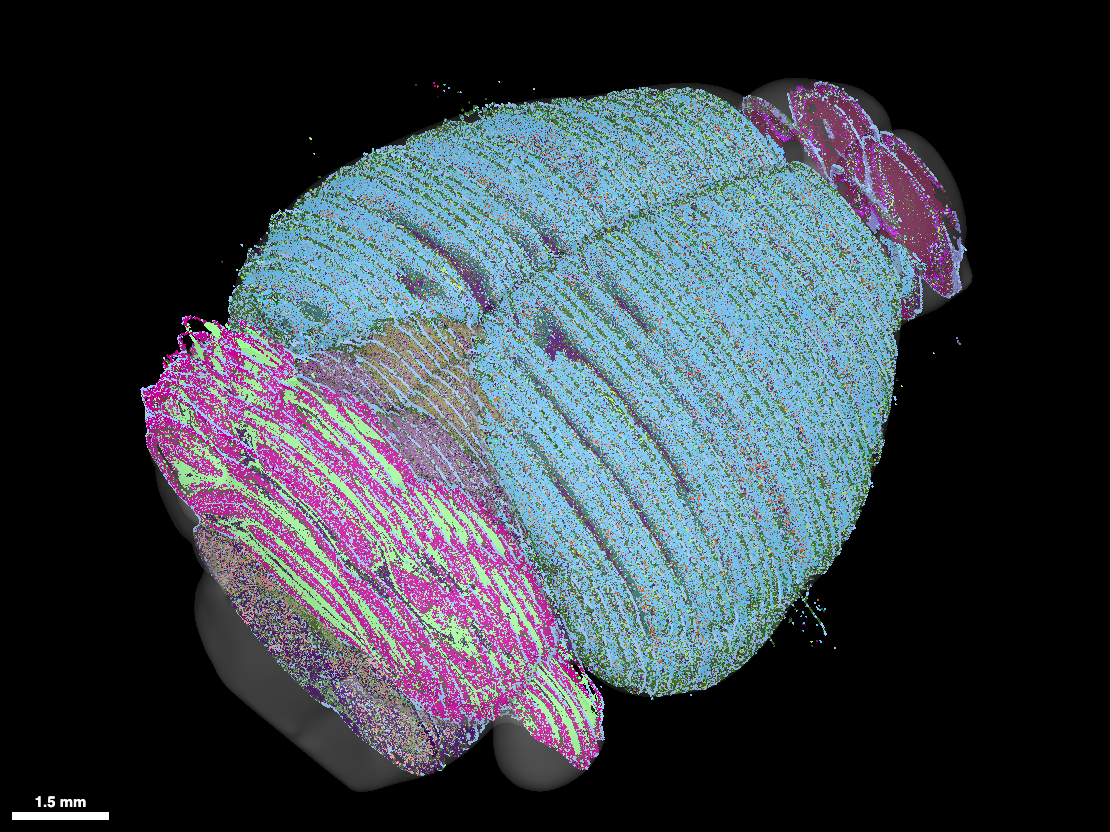
Use case: nucleus centroids from a cleared mouse brain. Each nucleus is an object with a volume attribute; nuclei are grouped by brain region; a pyramid supports coarse-to-fine viewing.
mouse_brain_nuclei.zarrvectors/
├── zarr.json                              # root: zarr_vectors, multiscales, ome
├── 0/
│   ├── zarr.json                          # kind "level"
│   ├── vertices/                          # kind "vertices"; c/0/0/0, …
│   ├── vertex_fragments/                  # kind "vertex_fragments"
│   ├── vertex_attributes/volume/          # kind "vertex_attribute"; µm³
│   ├── object_index/                      # kind "object_index"
│   │   ├── manifests                      # one manifest blob per nucleus
│   │   └── object_ids
│   ├── links/+1/0.0.0/                    # fine → coarse metavertex links
│   ├── groups                             # kind "groups"; G regions → object ids
│   └── group_attributes/region_id         # kind "group_attribute"; (G,)
├── 1/                                     # bin_shape 100; same OID space
│   ├── zarr.json
│   ├── vertices/, vertex_fragments/, object_index/
│   └── links/+1/, links/-1/
└── 2/                                     # bin_shape 200
Root attributes:
{
  "zarr_conventions": [
    {
      "schema_url": "https://raw.githubusercontent.com/Andrew-Keenlyside/zarr-vectors/refs/tags/v0.1.0/schema.json",
      "spec_url": "https://github.com/Andrew-Keenlyside/zarr-vectors/blob/v0.1.0/README.md",
      "uuid": "66268a61-7833-4995-bbcb-233bb417dae5", "name": "zarr_vectors",
      "description": "Spatially chunked, multi-resolution N-dimensional vector data (point clouds, meshes, skeletons, streamlines, graphs)"
    },
    {
      "schema_url": "https://raw.githubusercontent.com/zarr-conventions/multiscales/refs/tags/v0.1/schema.json",
      "spec_url": "https://github.com/zarr-conventions/multiscales/blob/v0.1/README.md",
      "uuid": "d35379db-88df-4056-af3a-620245f8e347", "name": "multiscales",
      "description": "Multiscale layout of zarr datasets"
    }
  ],
  "zarr_vectors": {
    "kind": "root", "zv_version": "0.10.0",
    "axes": [
      {"name": "x", "type": "space"}, {"name": "y", "type": "space"},
      {"name": "z", "type": "space"}
    ],
    "format_capabilities": [
      "preserved_object_ids", "shared_fragments", "multiscale_links"
    ],
    "chunk_shape": [200.0, 200.0, 200.0], "bounds": [[0, 0, 0], [1000, 1000, 1000]],
    "geometry_types": ["point_cloud"], "base_bin_shape": [50.0, 50.0, 50.0],
    "object_index_convention": "standard", "cross_chunk_strategy": "explicit_links",
    "cross_level_depth": 1, "cross_level_storage": "explicit"
  },
  "multiscales": {"layout": [{"asset": "0"}, {"asset": "1"}, {"asset": "2"}]},
  "ome": {
    "version": "0.6", "type": "collection", "name": "mouse_brain_nuclei", ...
  }
}
Level 1 (1/zarr.json). Its bins live here and nowhere else:
{
  "zarr_vectors": {
    "kind": "level", "level": 1, "object_sparsity": 0.5, "vertex_count": 171,
    "coarsening_method": "per_object", "parent_level": 0,
    "arrays_present": ["links", "object_index", "vertex_fragments", "vertices"],
    "preserves_object_ids": true, "inherited_num_objects": 400,
    "shared_fragments": true, "bin_ratio": [2.0, 2.0, 2.0],
    "bin_shape": [100.0, 100.0, 100.0]
  }
}
Arrays (0/vertex_attributes/volume, 0/object_index, 0/groups):
{"zarr_vectors": {"kind": "vertex_attribute", "nonempty_chunks": ["0.0.0", "0.0.1", ...],
                  "name": "volume", "dtype": "float32", "row_shape": []}}
{"zarr_vectors": {"kind": "object_index", "num_objects": 400, "num_present": 400,
                  "sid_ndim": 3, "layout": "vlen_manifests_v2", "object_ids_sorted": true}}
{"zarr_vectors": {"kind": "groups", "num_groups": 2}}
Notes:
One nucleus per object, one fragment per nucleus: a length-1 range
(start, 1)invertex_fragments/<chunk>, referenced by one mode-0 manifest block(chunk_coords, mode=0, fragment_index=k). The fragment index is what lets a manifest name a nucleus by chunk-local position, with no global vertex IDs.Without per-nucleus identity, the writer instead makes one fragment per bin (
200/50 = 4per axis → 64 per chunk) and noobject_index/; the fragment index is then only a sub-chunk spatial filter.boundsmax is inclusive of the last chunk:[0, 1000]with chunk 200 gives a grid of 6 per axis.+1/-1cross-level link arrays drill between levels (§9.6).
14.2 Mesh with Multi-Resolution (chunk-scale growth)¶
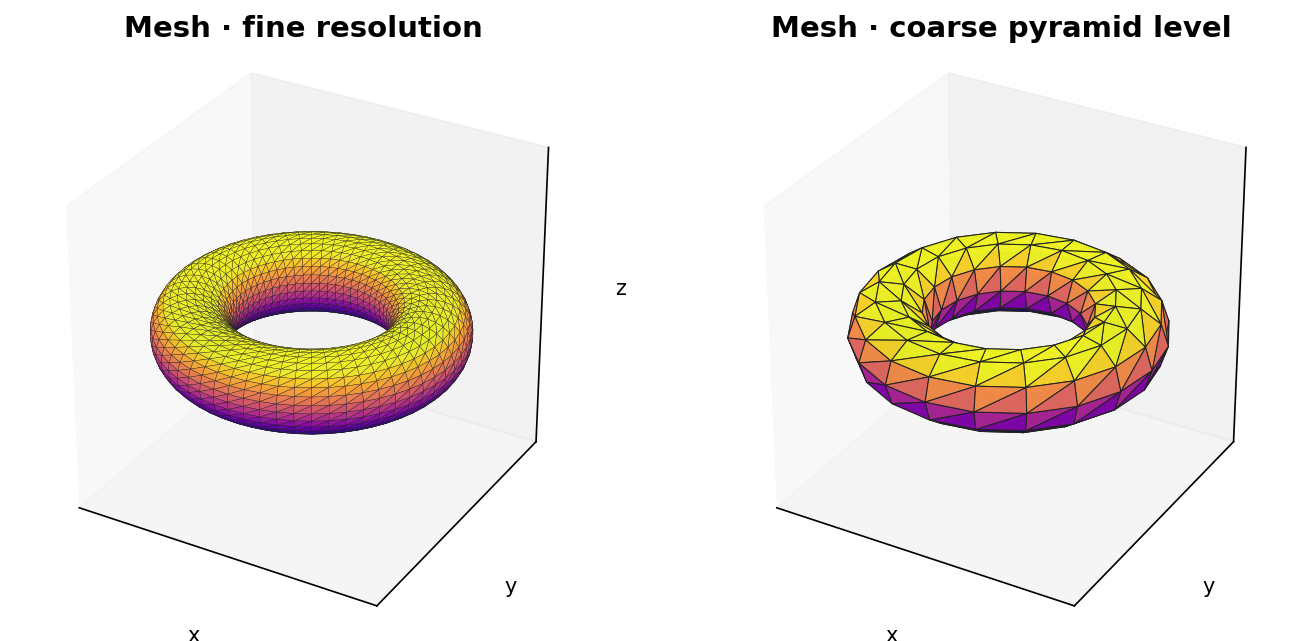
Use case: a triangulated surface (e.g. a Drosophila brain
compartment). Coarser levels grow the chunk shape so each coarse chunk
covers 2³ fine chunks.
drosophila_central_complex_mesh.zarrvectors/
├── zarr.json                              # geometry_types ["mesh"], links_convention "explicit"
├── 0/
│   ├── zarr.json                          # chunk_shape inherits root
│   ├── vertices/                          # encoding "raw" (or "draco")
│   ├── vertex_fragments/
│   ├── links/0/                           # kind "links_family", link_width 3
│   │   ├── 0.0.0_0.0.0/                   # faces inside one chunk
│   │   ├── 0.0.+1_0.0.+1/                 # faces straddling the +z seam
│   │   └── 0.0.+1_0.+1.0/                 # faces spanning three chunks
│   ├── link_fragments/                    # partitions links/0/0.0.0_0.0.0 only
│   └── object_index/
└── 1/                                     # chunk_shape = 2× root per axis
    ├── zarr.json
    ├── vertices/, vertex_fragments/, object_index/
    └── links/-1/                          # coarse → fine mapping
Level 1:
{
  "zarr_vectors": {
    "kind": "level", "level": 1, "object_sparsity": 1.0, "vertex_count": 9,
    "coarsening_method": "per_object", "parent_level": 0,
    "arrays_present": ["links", "object_index", "vertex_fragments", "vertices"],
    "chunk_shape": [400.0, 400.0, 400.0], "preserves_object_ids": true,
    "inherited_num_objects": 1, "shared_fragments": true, "bin_ratio": [2.0, 2.0, 2.0],
    "bin_shape": [400.0, 400.0, 400.0]
  }
}
Face family (0/links/0) and a seam array (0/links/0/+1.0.0_+1.0.0):
{"zarr_vectors": {"kind": "links_family", "level_delta": 0, "link_width": 3,
                  "directed": false, "store": "canonical", "sid_ndim": 3,
                  "num_links": 800, "num_physical_records": 800}}
{"zarr_vectors": {"kind": "links", "nonempty_chunks": [ ... ], "dtype": "int64",
                  "offsets": [[1, 0, 0], [1, 0, 0]], "has_perm": true,
                  "link_width": 3, "level_delta": 0}}
Notes:
arrays_presentlists family names only.Seam arrays in an undirected family carry
perm_idx(has_perm: true), which restores each face’s written winding.The grids nest: level-0 chunk
(2,3,4)lies in level-1 chunk(1,1,2).A
+1/-1record sits in its source chunk’s cell, and its offsets locate the other endpoint relative to that chunk re-anchored into the other level’s grid, so chunk-scale growth does not scatter one relationship across many offsets segments (§9.6).
14.3 Skeleton with Cross-Chunk Objects¶
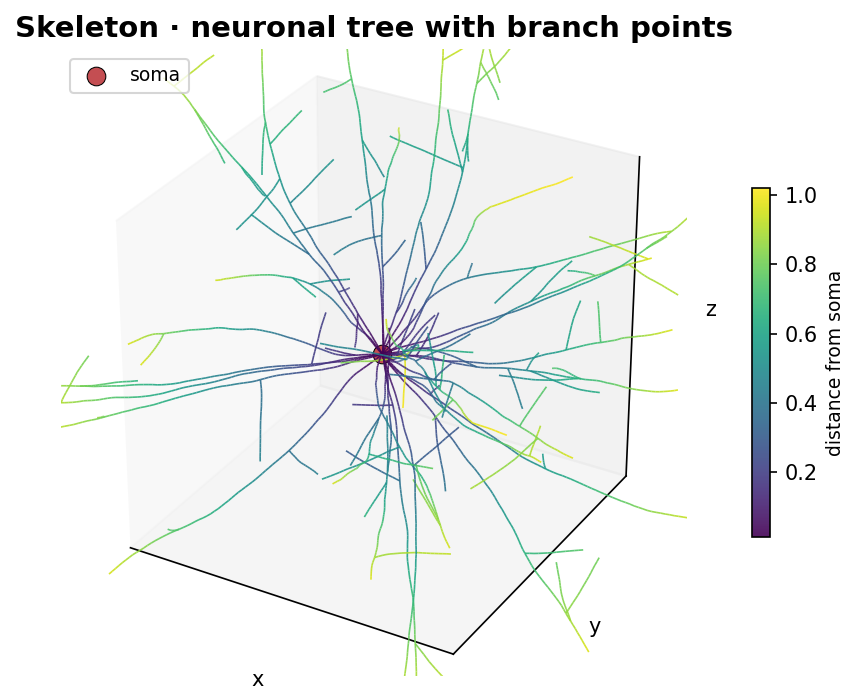
Use case: neuronal skeletons in a large volume; each neuron is one
object spanning many chunks. Parent edges (link_width = 2) form a
tree; most parents are sequential (parent = i − 1).
mouse_cortex_skeletons.zarrvectors/
├── zarr.json                              # links_convention "implicit_sequential_with_branches"
├── 0/
│   ├── zarr.json
│   ├── vertices/, vertex_fragments/       # one fragment per neuron piece per chunk
│   ├── links/0/                           # link_width 2
│   │   ├── 0.0.0/                         # branch links inside one chunk
│   │   └── 0.0.+1/                        # parent→child across the +z seam
│   ├── link_fragments/                    # partitions links/0/0.0.0 only
│   ├── vertex_attributes/
│   │   ├── vertex_type/                   # uint8: 1 soma, 2 axon, 3 dendrite
│   │   └── radius/                        # µm
│   └── object_index/                      # B = number of neurons
└── 1/ …                                   # per-object pyramid
Root object and parent-edge family:
{
  "kind": "root", "zv_version": "0.10.0", "format_capabilities": [],
  "geometry_types": ["skeleton"],
  "links_convention": "implicit_sequential_with_branches",
  "object_index_convention": "standard", "cross_chunk_strategy": "explicit_links",
  ...
}
{
  "zarr_vectors": {
    "kind": "links_family", "level_delta": 0, "link_width": 2, "directed": false,
    "store": "canonical", "sid_ndim": 3, "num_links": 67, "num_physical_records": 67
  }
}
Notes:
Implicit sequential parents leave
links/0/0.0.0with only branch links: ~50 rows for a 10k-vertex neuron with 50 branches. Edges that leave a chunk are always written.Neuron 42 might own fragment 3 of chunk
2.1.0and fragment 0 of2.1.1; its manifest is then two mode-0 blocks.A parent in
(2,1,0)with its child one step along+zis one record(parent_vi, child_vi)in thelinks/0/0.0.+1cell at(2,1,0). This family is undirected, so the record also carriesperm_idx; a writer that streams one chunk at a time writes"directed": trueand stores the order verbatim.
14.4 2-D Polylines with Attributes¶
Use case: blood-vessel centrelines in a 2-D slice, with radius per vertex.
retina_vessels_2d.zarrvectors/
├── zarr.json
├── 0/
│   ├── zarr.json
│   ├── vertices/, vertex_fragments/       # c/0/0, …
│   ├── links/0/                           # only where a vessel crosses a chunk
│   │   ├── 0.+1/
│   │   └── +1.0/, +1.-1/, +1.+1/
│   ├── vertex_attributes/radius/
│   └── object_index/
└── …
Root object:
{
  "kind": "root", "zv_version": "0.10.0",
  "axes": [{"name": "x", "type": "space"}, {"name": "y", "type": "space"}],
  "format_capabilities": [], "chunk_shape": [512.0, 512.0],
  "bounds": [[0, 0], [2048, 2048]], "geometry_types": ["polyline"],
  "links_convention": "implicit_sequential", "object_index_convention": "standard",
  "cross_chunk_strategy": "explicit_links"
}
One object per vessel, with one manifest block per chunk it passes
through. Offsets segments have two components (0.+1), matching
sid_ndim = 2.
14.5 Time-Series Point Cloud (XYZT)¶
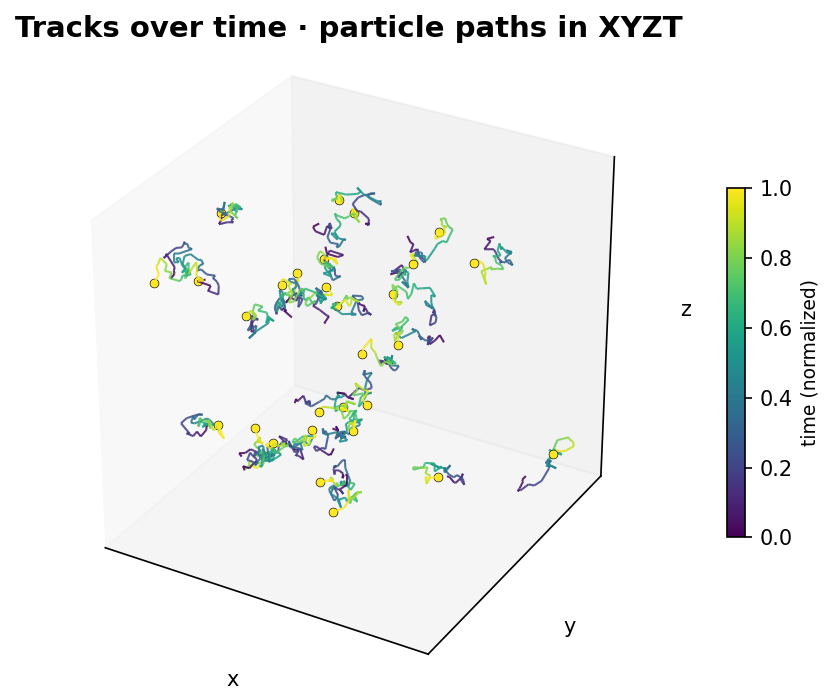
Use case: spots tracked in 3-D over time.
cell_tracks_xyzt.zarrvectors/
├── zarr.json
├── 0/
│   ├── vertices/                          # 4-D chunk grid: c/<t>/<z>/<y>/<x>
│   ├── vertex_fragments/
│   └── object_index/                      # one object = one track across t-chunks
└── …
Root object:
{
  "kind": "root", "zv_version": "0.10.0",
  "axes": [
    {"name": "t", "type": "time", "unit": "second"},
    {"name": "z", "type": "space", "unit": "micrometer"},
    {"name": "y", "type": "space", "unit": "micrometer"},
    {"name": "x", "type": "space", "unit": "micrometer"}
  ],
  "format_capabilities": [], "chunk_shape": [10.0, 128.0, 128.0, 128.0],
  "bounds": [[0, 0, 0, 0], [100, 512, 512, 512]], "geometry_types": ["point_cloud"]
}
Axes follow the order time → channel → custom → space. The time axis
is part of the spatial index (sid_ndim = 4) and is chunked like the
others, so a time-range query reads only the relevant t chunks.
14.6 Multiplexed FISH: Gene Measurements and Cell Types¶
Use case: MERFISH / seqFISH. Each vertex is a cell centroid with gene counts (many channels) and a cell type; objects are cells; groups are cell-type clusters.
merfish_celltype.zarrvectors/
├── zarr.json
├── 0/
│   ├── vertices/, vertex_fragments/       # XY cell positions
│   ├── vertex_attributes/
│   │   ├── gene_expression/               # row_shape [num_genes]
│   │   └── cell_type/                     # uint16
│   ├── object_index/
│   ├── groups                             # G cell-type clusters
│   └── group_attributes/
│       ├── cell_type_name
│       └── super_type                     # e.g. "neuron", "glia"
└── …
A multi-channel vertex attribute (three channels shown; with no
names given, the writer labels them ch0 …):
{"zarr_vectors": {"kind": "vertex_attribute", "nonempty_chunks": ["0.0.0", ...],
                  "name": "expr", "dtype": "float32",
                  "channel_names": ["ch0", "ch1", "ch2"], "row_shape": [3]}}
row_shape gives the column count; channel_names are only labels.
When the gene axis is large, a level can be chunked by an attribute,
which adds a leading bin axis to every per-chunk array and records it in
the level object
(§8.3):
{
  "zarr_vectors": {
    "kind": "level", "chunk_dims": ["gene", "x", "y", "z"],
    "chunk_attribute_name": "gene",
    "chunk_attribute_values": ["Gad1", "Pvalb", "Slc17a7"], ...
  }
}
Hierarchical typing (super_type) is a group attribute, not a tree.
14.7 Individual Gene Detections in mFISH (Spots → Cells)¶
Use case: each vertex is one transcript spot; spots agglomerate into cells (objects), many spots per cell.
mfish_spots_cells.zarrvectors/
├── zarr.json
├── 0/
│   ├── vertices/, vertex_fragments/       # XYZ per spot
│   ├── vertex_attributes/
│   │   ├── gene_id/, intensity/, round/
│   ├── object_index/                      # one object per cell
│   ├── object_attributes/
│   │   ├── cell_type                      # (B,)
│   │   └── centroid                       # (B, 3)
│   └── groups                             # optional cell-type clusters
└── …
object_attributes/centroid:
{
  "zarr_vectors": {
    "kind": "object_attribute", "name": "centroid", "dtype": "float32",
    "shape": [20, 3], "fill_sentinel_meaning": "absent"
  }
}
A cell spanning chunks gets one manifest block per chunk; within a chunk
its spots are a range (mode 1) or an explicit list (mode 2). A cell with
no centroid reads back as the array’s fill_value (NaN), not a zero
row. With many cells, the dense object index (§14.11) avoids one byte
blob per cell.
14.8 Simple DTI: Small Volume (TRX-Aligned)¶
Use case: a small tractography dataset where spatial chunking is unnecessary. The store has one spatial chunk and aligns with the TRX format.
TRX |
Zarr Vectors |
|---|---|
|
|
|
|
|
|
|
|
|
|
|
|
|
root |
dti_small.trx.zarrvectors/
├── zarr.json                              # object_index_convention "identity"
└── 0/
    ├── vertices/c/0/0/0                   # all positions in one cell
    ├── vertex_fragments/c/0/0/0           # ranges = TRX offsets
    ├── vertex_attributes/fa/, color/      # color: row_shape [3], uint8
    ├── object_attributes/algo, clusters_QB, commit_weights
    ├── groups                             # G tracts → streamline ids
    └── group_attributes/tract_name, mean_fa, shuffle_colors, volume
Root object and a group attribute:
{
  "kind": "root", "zv_version": "0.10.0",
  "axes": [
    {"name": "x", "type": "space", "unit": "millimeter"},
    {"name": "y", "type": "space", "unit": "millimeter"},
    {"name": "z", "type": "space", "unit": "millimeter"}
  ],
  "format_capabilities": [], "chunk_shape": [100.0, 100.0, 100.0],
  "bounds": [[0, 0, 0], [99, 99, 99]], "geometry_types": ["streamline"],
  "links_convention": "implicit_sequential", "object_index_convention": "identity"
}
{
  "zarr_vectors": {
    "kind": "group_attribute", "name": "mean_fa", "dtype": "float32", "shape": [2]
  }
}
chunk_shape covers the bounds, so every per-chunk array has one cell.
Under the identity convention object_index/ is omitted and object IDs
equal fragment indices. No streamline leaves the chunk, so there is no
links/ group.
14.9 DTI Streamlines: Large Volume with Chunking and Segment Reuse¶
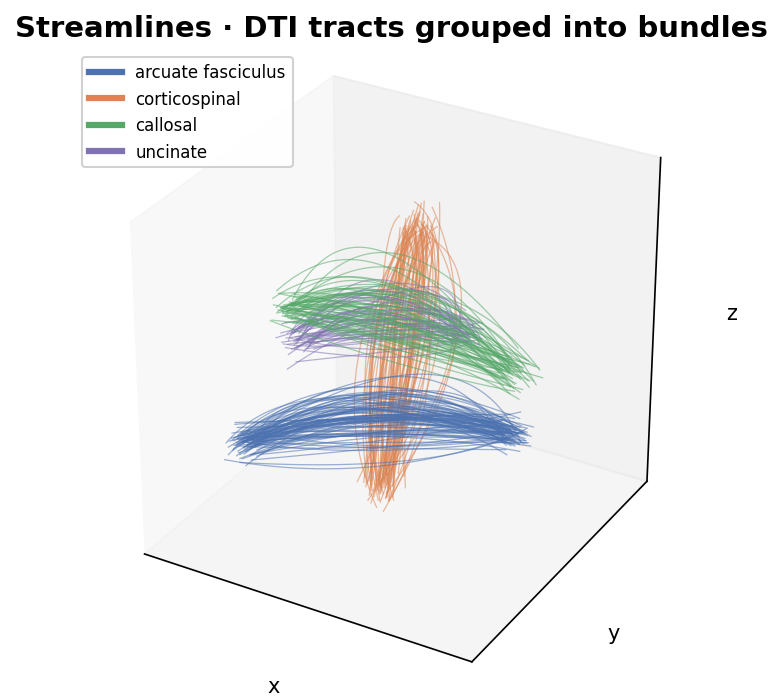
Use case: tractography streamlines from a large brain, grouped into tracts. Segments within a chunk are stored once and shared by several streamlines (shared fragments). Coarser levels hold downsampled streamlines.
dti_tracts.zarrvectors/
├── zarr.json                              # cross_level_storage "implicit"
├── 0/
│   ├── vertices/, vertex_fragments/       # one fragment per shared segment
│   ├── links/
│   │   ├── 0/                             # continuation across seams
│   │   │   ├── 0.0.+1/, 0.+1.0/, +1.0.0/, …
│   │   └── +1/0.0.0/                      # fine → coarse
│   ├── object_index/                      # one object per streamline
│   ├── object_attributes/termination      # (B, 2): source / sink region ids
│   ├── groups                             # G tracts
│   └── group_attributes/tract_name
├── 1/ …                                   # bin_ratio 2; links/+1/ only
└── 2/ …                                   # bin_ratio 4
Root object:
{
  "kind": "root", "zv_version": "0.10.0",
  "axes": [
    {"name": "x", "type": "space"}, {"name": "y", "type": "space"},
    {"name": "z", "type": "space"}
  ],
  "format_capabilities": [
    "preserved_object_ids", "shared_fragments", "multiscale_links"
  ],
  "chunk_shape": [200.0, 200.0, 200.0], "bounds": [[0, 0, 0], [400, 400, 400]],
  "geometry_types": ["streamline"], "base_bin_shape": [50.0, 50.0, 50.0],
  "links_convention": "implicit_sequential", "object_index_convention": "standard",
  "cross_chunk_strategy": "explicit_links", "cross_level_depth": 1,
  "cross_level_storage": "implicit"
}
object_attributes/termination at level 1 (the OID space is
inherited, so the shape is unchanged):
{
  "zarr_vectors": {
    "kind": "object_attribute", "name": "termination", "dtype": "int32",
    "shape": [20, 2], "fill_sentinel_meaning": "absent"
  }
}
Notes:
A shared fragment in chunk C may be named by many manifests; mode-2 blocks list a streamline’s ordered fragments within one chunk.
Each segment-end → next-segment-start is one
link_width = 2record inlinks/0/<offsets>, in the source chunk’s cell.With
cross_level_storage = "implicit"onlylinks/+1/is written; readers invert it for coarse → fine.
14.10 Large-Scale Distributed Write¶
Use case: many workers write skeleton fragments into the same store (layout as in §14.3).
Chunk-local writes are independent: each cell of
vertices,vertex_fragments,links/0/<offsets>,link_fragmentsandvertex_attributes/<name>is its own object, and fragment numbering is chunk-local.Presence is shared state:
nonempty_chunksis one field per array, so per-cell writers MUST NOT update it. A coordinator defers presence first: the level object gains"presence": "deferred"and the arrays dropnonempty_chunks, so readers list the store instead. Afterwards it writes everynonempty_chunksand removespresence(§8).{"zarr_vectors": {"kind": "level", "level": 0, "vertex_count": 100, ..., "presence": "deferred"}} {"zarr_vectors": {"kind": "vertices", "dtype": "float32", "encoding": "raw"}}
Global arrays need coordination:
object_index/andgroupsare level-global. Writers serialize updates or use a transactional backend (e.g. icechunk).Sharding changes the unit of contention: writers in different shards are independent; two writers in one shard must serialize. Give each worker whole shards, or write unsharded and shard once at the end, after presence is rebuilt.
Capabilities: segment reuse adds
shared_fragments; an OID-preserving pyramid addspreserved_object_ids.
Summary¶
Example |
sid_ndim |
Objects |
links_convention |
Vertex attributes |
Groups |
|---|---|---|---|---|---|
14.1 Mouse nuclei |
3 |
nuclei |
(not written) |
volume |
region_id |
14.2 Mesh pyramid |
3 |
mesh |
explicit (link_width 3) |
— |
— |
14.3 Skeletons |
3 |
neurons |
implicit_sequential_with_branches |
vertex_type, radius |
— |
14.4 Polylines |
2 |
vessels |
implicit_sequential |
radius |
— |
14.5 Tracks |
4 (TZYX) |
tracks |
— |
— |
— |
14.6 Multiplexed FISH |
2 |
cells |
— |
gene_expression, cell_type |
cell_type_name, super_type |
14.7 mFISH spots → cells |
3 |
cells (many spots) |
— |
gene_id, intensity, round |
optional |
14.8 Simple DTI (TRX) |
3 |
streamlines (single chunk) |
implicit_sequential |
fa, color |
mean_fa, … |
14.9 DTI streamlines |
3 |
streamlines |
implicit_sequential |
— (obj: termination) |
tract_name |
14.10 Distributed write |
3 |
(as 14.3) |
implicit_sequential_with_branches |
— |
— |
14.11 Sharded / dense |
3 |
points |
— |
intensity |
— |